
Wasp & Hornet Control
Professional wasp nest treatment and hornet control across the North East. NPTA member company, same-day response, single-visit resolution for most nests. Asian hornet awareness.
Why You Need Professional Wasp & Hornet Control
Being stung by a wasp can be very painful, and for some people it can be life-threatening if they are allergic to stings. While wasps play an important role in the ecosystem as natural pest controllers and contributors to pollination, their stings pose a serious health risk near homes, businesses, and outdoor dining areas. By taking sensible precautions and proactively managing nests, you can stay one step ahead of the colony before they become a problem. Wasps should only be removed if they pose a direct risk to people.
What's Included
Why acting quickly matters
A colony may have as many as 25,000 individual wasps by late summer. Nests grow rapidly and wasps become significantly more aggressive as the season progresses. Early treatment when the nest is still small is safer, simpler, and more effective.
Emergency Wasp Nest Treatment
Wasp nests near entrances, play areas, or outdoor dining areas require urgent treatment. We offer same-day response for wasp and hornet nests across the North East.
Request a free call back
Prefer to get in touch another way? Contact us or email info@wynyardpestcontrol.co.uk
Related Services
Threat Assessment
Nuisance:
7/10HIGHWasps become highly aggressive in late summer as their sugar supply from larvae runs out. Outdoor dining, beer gardens, and food preparation areas are significantly disrupted. Nests in lofts, wall cavities, and sheds cause distress and restrict access.
Hazard:
9/10VERY HIGHWasp stings cause intense pain and can trigger life-threatening anaphylaxis in people with hymenoptera venom allergy. A disturbed colony can mobilise hundreds of wasps to sting in defence. Hornet stings are even more painful due to higher acetylcholine concentration.
Vital Statistics
| Common species (UK) | Common Wasp, German Wasp, European Hornet |
| Worker size | 12 to 17 mm (wasps), up to 40 mm (hornets) |
| Colony size (wasps) | Up to 25,000 individuals |
| Colony size (hornets) | Up to 700 workers |
| Sting risk | Females sting repeatedly. Anaphylaxis risk for allergic individuals |
| Nest material | Chewed wood pulp and saliva (papery texture) |
| Nest lifespan | One season only. Wasps never reuse old nests |
| Diet (workers) | Insects (protein) in early summer, sugar in late summer |
| Active period | April to October, peak aggression August to September |
| Invasive species | Asian Hornet (Vespa velutina) - increasing UK concern |
Key Facts
- Only female wasps sting, and they can do so repeatedly. A sting can be life-threatening for people with hymenoptera venom allergy (HVA)
- When a wasp is harmed, it releases a distress pheromone that alerts the entire colony to defend the nest
- Hornet venom contains a higher concentration of acetylcholine, making stings more painful than wasp stings
- Asian hornets are a non-native invasive species that pose a serious threat to UK honeybees and pollinators
- In late summer, wasps lose their sugar supply from larvae and become much more irritable and aggressive around food and drink
- Wasps never reuse an old nest, but a new queen may build in the same location if entry points remain open
- A wasp nest starts the size of a golf ball in spring and can reach football size or larger by late summer
- European hornets will forage at dusk and can be disorientated by lights during twilight hours
- Honey bees should not be treated as pests. Contact a local beekeeper if you have a honey bee swarm
- Wasps are beneficial as natural pest controllers, eating aphids and caterpillars, and contributing to pollination
"Top service, fast and responsive"
Christopher Nottingham · Google review, April 2026
Wasp Nest Near Your Home or Business?
Do not risk a sting by attempting to treat a nest yourself. Contact us now for same-day professional treatment. Our trained technicians carry full protective equipment and resolve most nests in a single visit.
Identification: Wasps, Hornets, and Bees
Wasps are distinguished from bees by their slender waists and signature yellow-and-black stripes. They have much less hair on their bodies than bees and a tighter waist between the thorax and abdomen. Unlike bees, a single female wasp can sting repeatedly if she feels her nest is under threat.
Common and German Wasp
Family: Vespidae, Vespula vulgaris and Vespula germanica
These are the two most commonly found wasp species in the UK and responsible for the vast majority of painful stings. They prefer to build nests in sheltered locations with easy access to the outside, such as lofts, garages, and wall cavities. Outside they may nest in old rodent burrows, hollow trees, and bushes.
- Workers vary in size from 12 to 17 mm
- Yellow and black body, markings vary according to species
- A colony may have as many as 25,000 individual wasps
- Only female wasps sting, and they can do so readily and repeatedly
- The nest dies during winter, including all males and workers. Only young queens survive over winter.
German Wasp: Key Differences
The German wasp can be identified by three black dots on the face (the common wasp has anchor-shaped markings instead). German wasps tend to build larger nests, often underground or in structural voids such as cavity walls and beneath decking. They can be more aggressive when disturbed than common wasps, making early-season treatment particularly important.
European Hornet
Vespa crabro
Hornets are not common in the UK. If you do see them on your property, it is likely to be the European hornet. Although they are less aggressive than wasps, they may still sting repeatedly to defend their nest against any threat.
- Large insects, up to 40 mm long
- Distinctive orange abdomen with brown stripes (compared to the black and yellow pattern of wasps)
- A colony can reach a size of 700 workers
- Hornets can bite and sting at the same time
- They can mobilise the entire nest to sting in defence, which is highly dangerous to humans
- Unlike wasps, European hornets will forage for food at dusk and can be disorientated by lights during twilight hours
- Hornets strip bark from oak, ash, birch, lilac, rhododendron, and boxwood plants to harvest sap, a behaviour known as girdling, which can seriously damage affected plants
Asian Hornet: An Increasing Concern
Asian hornets are a notifiable invasive species. If you suspect an Asian hornet nest, do not approach it. Report sightings immediately via the GB Non-Native Species Rapid Response app or contact APHA.
Vespa velutina
The Asian hornet, also known as the yellow-legged hornet, is a non-native invasive species that has been steadily spreading across Europe and is now an increasing concern in the UK. It poses a serious threat to native honeybees and other pollinators.
Despite frequent media coverage referencing "giant Asian hornets", the Asian hornet is actually smaller than the European hornet. Sightings in the UK remain relatively rare but are increasing year on year.
How to Identify Asian Hornets
- Smaller than native European hornets
- Bright yellow-tipped legs and feet
- Black or deep brown, velvety abdomen
- Only the fourth segment of the abdomen is almost entirely yellow or orange
- Not active at night (European hornets are occasionally active from dusk into night)
If you believe you have spotted an Asian hornet nest, do not approach or attempt to treat it. Report sightings via the GB Non-Native Species Rapid Response app or contact the Animal and Plant Health Agency (APHA). Professional treatment is essential.
Bees: Identification and Protection
Wasps are often confused with bees. However, bees are a valuable part of our ecosystem and should not be treated as pests.
Honey Bee (Apis mellifera)
- Vary in colour from golden brown to almost black and are furrier than wasps
- A colony size can often be greater than 30,000 individual honey bees
- They live in hollow trees or in chimneys, wall cavities, or roof spaces
- Population under threat from the varroa mite
If you suspect you have honey bees, contact a local beekeeper or visit the British Beekeepers Association to find a swarm collector in your area.
Bumble Bee (Bombus sp.)
Larger and furrier than honey bees, dark coloured except for golden stripes across the end of their tails. They nest in small wall cavities, holes in the ground, under sheds, or in undisturbed compost heaps.
Solitary and Mason Bees
Solitary bees live alone but nest near each other in suitable nesting sites. They do not swarm and are not aggressive. Mason bees nest in crevices or holes in masonry and are harmless. Neither species requires pest control treatment. For bee-related concerns, we always prioritise ethical relocation over treatment.
Signs of Wasp Nests
If there is a high volume of wasps in your home or garden, there is likely a nest nearby. A mature nest in summer can contain thousands of wasps. It is important to treat a wasp nest early to reduce the threat of stings.
Identifying a Wasp Nest
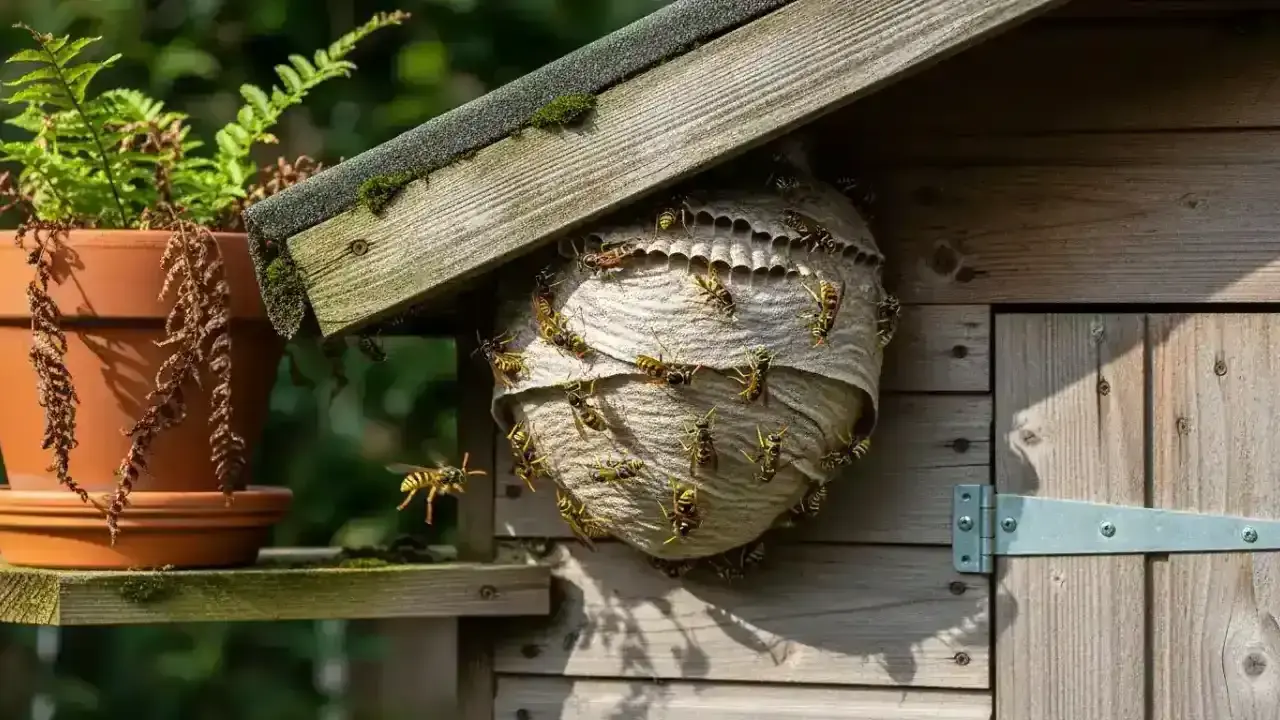
Wasps make their nests from chewed wood pulp and saliva, giving them distinctive papery walls. Nests are usually built in sheltered spots with easy access to the outside. To locate a nest, carefully watch the flight path of returning worker wasps to your property or garden.
Common Nesting Hotspots
- Garden structures: sheds, garages, and bird boxes
- Hidden voids: attics, lofts, and wall cavities
- High-traffic areas: underneath decking, porches, and eaves
- Roof spaces and eaves
Nest Size Progression
A wasp nest starts very small, around the size of a golf ball or walnut, when the queen begins building in spring. During summer the nest grows as the number of wasps increases and can reach the size of a football or larger. It is best to treat a wasp nest earlier in the year before numbers increase and wasps become more aggressive in late summer.
Seasonal Wasp & Hornet Activity in the North East
Hover or tap a month to see Wasp & Hornet activity details
Queens hibernating in sheltered, frost-free locations. No active colonies.
Queens remain dormant. No wasp activity.
Queens begin emerging as temperatures rise. Scouting for nesting sites begins.
Queens start building golf-ball-sized starter nests. Best time for spring audit and early treatment.
First worker wasps hatch and take over foraging and nest building. Colony begins growing.
Colony expanding rapidly. Workers seek protein to feed larvae. Nests becoming larger.
Peak colony growth. Nests may contain thousands of wasps. Increased activity around properties.
Peak aggression. Workers lose sugar supply from larvae and scavenge sugary foods and drinks aggressively.
Colony at peak population. New queens and males produced. Workers highly irritable and prone to stinging.
Colony declining. First frosts begin killing off workers. New queens seek hibernation sites.
Colony collapses. Nest becomes inactive. Only mated queens survive in hibernation.
No active colonies. Queens overwintering. Good time to seal potential nesting entry points.
Late summer is when wasp stings are most common. As the colony breaks down, workers become erratic and aggressive - targeting outdoor food, drinks, and bins. Restaurants, pubs with beer gardens, and schools see the highest sting risk between August and October.
Seeing a steady stream of wasps entering a gap in your roof, wall, or shed? That is a nest. Do not block the entrance - call us for safe, same-day treatment.
Spring (March to May) - Founding phase: Queen wasps emerge from hibernation and begin building a golf-ball-sized starter nest from chewed wood pulp. Each queen is the sole survivor of a previous colony, working alone until the first workers hatch. Watch for: small papery structures forming under eaves, in sheds, loft spaces, and bird boxes; a steady stream of a single wasp entering and leaving a gap; and new nests appearing in unexpected spots such as garden sheds and bird boxes across Hartlepool, Sunderland, and Durham. This is the easiest and cheapest stage to treat - one queen, one small nest.
Summer (June to August) - Rapid colony growth: Worker wasps take over foraging and construction while the queen focuses on egg-laying. The colony grows fast - by late July a nest can contain 5,000 to 10,000 workers. Watch for: increasing wasp numbers around your property, a visible nest growing in size (from golf ball to football), wasps becoming defensive if you approach within a few metres of the nest entrance, and a constant stream of wasps flying to and from a single entry point. Do not attempt to block the entrance or treat the nest yourself at this stage.
Autumn (September to November) - Peak aggression and sting risk: The queen stops producing workers and shifts to new queens and males. Existing workers, no longer needed by the colony, become erratic and scavenge for sugary food. Sting risk is highest during this period. Watch for: wasps persistently hovering around outdoor dining areas, beer gardens, and fallen fruit; wasps entering open drinks and food packaging; aggressive behaviour near the nest entrance as the colony breaks down; and increased call-outs from properties in Darlington, Stockton, and Middlesbrough with outdoor seating areas. Hospitality and education premises should treat nests before this phase.
Winter (December to February) - Colony dies off: The first hard frosts kill all workers and males. Only newly mated queens survive by hibernating in sheltered, frost-free spots such as wall cavities, woodpiles, and folded garden furniture. The old nest is never reused. Watch for: hibernating queens in stored items when spring cleaning sheds or lofts, and old nest material in loft spaces and cavity walls. This is the ideal time for prevention: seal gaps around eaves, fascias, and shed walls to reduce nesting sites for the following year.
Why Choose Us for Wasp & Hornet Control
Same-Day Response
We treat most wasp nests on the same day you contact us during the season.
One-Visit Resolution
Nests are typically eliminated in a single visit with no need for return appointments.
NPTA Member Company
We are NPTA members, and our trained technicians carry specialist protective equipment.
All Nest Locations
We treat nests in lofts, wall cavities, underground, sheds, and other hard-to-reach locations.
Commercial Solutions
EcoCatch traps, Lumnia LED units, and insect screens for ongoing business protection.
Wasp and Hornet Stings
During wasp season, anyone with an allergy to wasps should always carry an emergency kit containing an adrenaline spray, fast-acting antihistamine, and cortisone preparation.
A sting by a common wasp is a painful experience. Only female wasps have a sting, which they can use repeatedly if they feel under threat. In most cases a wasp sting causes no long-term harm, but it can be life-threatening for people who are allergic.
Symptoms
- Burning sensation
- Red swelling at the sting site
Anaphylaxis
Wasps carry venom in their stings that may be life-threatening to people who are allergic. This allergic reaction is known as anaphylaxis. People who have been stung several times previously and have become sensitised are more likely to suffer this systemic reaction.
When to Call an Ambulance
- Difficulty breathing or wheezing
- Swollen face or mouth
- Problems swallowing
- Feeling faint or dizzy
- Nausea, vomiting, or diarrhoea
Treating Wasp Stings
- Use a cold compress such as an ice pack or cold flannel
- Take painkillers such as paracetamol or ibuprofen to soothe pain
- Take antihistamine tablets to reduce any small localised swelling
- Press the wasp venom out of the wound, but do not suck the poison out
- If in any doubt, consult a doctor or medical professional
Hornet Stings
Hornet stings are generally more painful than wasp stings because hornet venom contains a higher concentration of acetylcholine, a pain-stimulating chemical. The same anaphylaxis risk applies. Anyone with a known allergy to hymenoptera venom should treat a hornet sting with the same urgency as a wasp sting.
Bee Stings
Unlike wasps and hornets, honey bees can only sting once. The bee's stinger has a barbed tip that anchors into the skin. Remove the stinger as quickly as possible by scraping it out sideways using a fingernail or bank card edge. Do not squeeze or pinch the venom sac, as this forces more venom into the wound.
Tips to Avoid Wasp Stings
- Stay clean: Ensure hands and faces (especially children's) are cleaned after eating sweet foods or drinks
- Cover food and drink: Always keep food and drink covered when eating outdoors
- Avoid open drinks: Unattended cans or bottles may encourage wasps to crawl inside
- Avoid orchards: Stay away from soft fruit plants and uncovered bins where wasps gather
- Avoid bright colours: Do not wear bright, bold floral patterns on clothes and bags
- Avoid strong, sweet smells: Do not use highly perfumed fragrances, shampoos, or hair sprays. Opt for neutral scents during outdoor gatherings
- Do not panic: If wasps are nearby, keep calm and move slowly away. Do not scream, flap arms, or swat them, as this agitates them and makes them more aggressive
If wasps become a recurring problem, consider a broader integrated pest management approach alongside fly control measures to reduce all flying insect activity around your property. We cover Newcastle, North Shields, and all areas across the North East.
Professional Nest Treatment
Treating a wasp nest is the most efficient way to control a wasp problem and eliminate the threat of stings. Because wasps become highly aggressive when their nest is disturbed, professional treatment is always recommended.
A mature wasp nest found in late summer will almost certainly require professional treatment due to the high risk of stings. By this stage, a nest may contain thousands of individual wasps.
Professional treatment includes:
- Trained technicians with expert knowledge about the lifecycle and habits of wasps and hornets
- Inspection: technician arranges a convenient time to inspect the nest location
- Treatment: a single 30 to 45 minute visit to treat the nest, customised based on its location
- All technicians equipped with special protective gear
- Expert advice on preventing future problems
- Guaranteed treatment within two working days
Post-Treatment Nest Removal
A wasp nest should not be removed directly after treatment. It can take several days for foraging worker wasps to return to the nest and be affected. As wasps return and enter the nest, they are also contaminated by the treatment and die off, ensuring the whole colony is effectively treated. Nest removal can be arranged at least 48 hours after treatment.
Hornet Nest Treatment
The same professional treatment process applies to hornet nests. Our trained technicians inspect, explain the treatment process, and professionally treat a single nest in a 30 to 45 minute visit.
Wasp Prevention
Preventing a wasp problem is always easier than dealing with an established infestation. While wasps never reuse an old nest, a queen will often return to the same general area if she finds it suitable.
1. Conduct a Spring Audit
In early spring, scout your loft, garage, shed, eaves, and garden for new nests. At this early stage, they are often no larger than a walnut or golf ball. Smaller nests house fewer wasps, making them much safer and quicker to treat.
2. Manage Food and Waste
- Clear the buffet: In early summer, wasps seek protein to feed larvae. Remove leftover pet food or outdoor snacks. By late summer, they crave sugar, so ensure food and drink are covered and spills are cleared quickly
- Secure your bins: Ensure outdoor bins have tight-fitting lids and are located well away from doors, windows, and seating areas
- The imprint effect: Wasps imprint on food sources. Even after food is removed, they may continue to return to the same spot for several days
3. Smart Property Habits
- Aromatic deterrents: Planting aromatic herbs like spearmint, thyme, and eucalyptus may naturally discourage wasps from settling in your garden
- Birdhouse protection: Line the underside of birdhouse roofs with aluminium foil to prevent wasps from colonising them
- Entry points: Keep windows and doors closed when possible, and use fly screens to enjoy the breeze without uninvited guests
- Regular maintenance: Ensure all cracks and potential entry points are sealed
4. Personal Precautions
- If you discover an active nest, keep children and pets at a safe distance. Never attempt to disturb or knock down a nest yourself
- Strong, sweet, and floral perfumes are highly attractive to wasps, particularly toward the end of summer. Opt for neutral scents during outdoor gatherings
Our Wasp & Hornet Control Process
A structured, three-stage approach that treats the problem and prevents it returning.
Step 1
Inspect and Plan
A detailed property inspection identifies entry points, infestation hotspots, and the species involved. A targeted treatment plan is developed based on findings.
Step 2
Treatment
Professional control measures are applied using advanced techniques and CRRU-compliant products. Proofing and sealing work addresses the root cause at the same time.
Step 3
Ongoing Support
Follow-up visits confirm the problem is resolved. You receive clear documentation, prevention advice, and recommendations for ongoing protection.
Wasp Nest Near Your Home or Business?
Do not risk a sting by attempting to treat a nest yourself. Contact us now for same-day professional treatment. Our trained technicians carry full protective equipment and resolve most nests in a single visit.
DIY vs Wynyard Pest Control
DIY treatment of a large or mature wasp nest is dangerous. A disturbed colony can mobilise hundreds of wasps to sting in defence. Professional treatment is always recommended for nests larger than a tennis ball.
| DIY | Wynyard Pest Control | |
|---|---|---|
| Best for | Small, accessible nest in early spring | Any nest larger than a tennis ball |
| Sting risk | ✗ High if colony disturbed | ✓ Protective equipment and training |
| Nest fully treated | ⚠ Surface spray only | ✓ Insecticidal dust reaches all chambers |
| Pet and child safe | ⚠ Spray drift risk | ✓ Controlled, targeted application |
| Effectiveness | May not reach hidden nests | Colony eliminated within 24 to 48 hours |
| Follow-up visits | ✗ None | ✓ Free return if activity continues |
| Guarantee | ✗ None | ✓ Nest elimination guaranteed |
When DIY may be sufficient: A small, accessible nest discovered in early spring (golf-ball sized), with minimal wasp activity, where no one in the household is allergic to stings. Treat at dusk when all wasps have returned to the nest.
When you need Wynyard Pest Control: Any nest larger than a tennis ball, any nest in a wall cavity, roof space, or hard-to-reach location, or any situation involving people with sting allergies. Properties across Hartlepool, Darlington, and Sunderland regularly call us after failed DIY attempts have aggravated the colony.
Do I Need to Remove the Nest?
Dead wasp nests do not need to be removed for the treatment to be successful. Once the colony is eliminated, the nest is inert and will naturally dry out and decompose over autumn and winter.
Nests in accessible locations (loft spaces, sheds, outbuildings) can be removed at least 48 hours after professional treatment if preferred. Dead nests left in wall cavities will not cause further infestation.
Wasps never reuse old nests. However, a new queen may build a nest in the same location the following spring if entry points remain open. Seal them once the nest is confirmed dead.
Wasp Control for Businesses
EcoCatch wasp traps are non-toxic, completely reusable, and up to 26% more effective than traditional wasp pots. Over 30% of EcoCatch is made from recycled plastics.
A wasp problem at work is an unwanted distraction for customers and employees. Wasps can be a health and safety issue due to the risk of stings and allergic reactions (anaphylaxis). They may also contaminate food, produce, and stock, or damage property when constructing nests.
Key Commercial Scenarios
- Hospitality and outdoor dining: Nests near beer gardens, patios, and service areas cause significant disruption and present liability if customers are stung
- Food production and processing: Wasps attracted to sugary residues and fruit present a hygiene risk near food handling areas
- Construction and maintenance: Workers near roof spaces, eaves, and structural voids face elevated risk of accidental nest disturbance
- Schools and care settings: Any stinging risk near vulnerable individuals requires immediate professional response
- Rental properties: Landlords and letting agents have a responsibility to address wasp nests reported by tenants promptly
We provide commercial wasp and hornet control across the North East, including Hartlepool, Durham, and Sunderland. Learn more about how we work with businesses to deliver fast, reliable pest management.
Commercial Solutions
- EcoCatch Wasp Traps: Practical, discreet, non-toxic, reusable wasp catchers suitable for protecting all external locations including hospitality venues and food manufacturing facilities. Up to 26% more effective at catching wasps than traditional dome wasp pots.
- Lumnia LED Units: For food preparation areas, these units deal with all flying insects including wasps, reducing the risk of contamination from dead insect fragments
- Insect Screens: On doors or windows to prevent wasps entering the workplace while allowing natural ventilation
Treatment Programme
A single professional treatment is sufficient in the vast majority of cases. Wasps die within 24 to 48 hours of contact with the insecticidal dust or spray applied to the nest.
Before Treatment: How to Prepare
- Keep children and pets well away from the nest area before and on the day of treatment
- Do NOT attempt to block the nest entrance. This traps wasps inside, makes them more aggressive, and significantly increases the sting risk during treatment
- Do not spray the nest with DIY products before the technician arrives. This agitates the colony and makes professional treatment harder and more dangerous
- If the nest is in a loft, ensure the loft hatch is accessible and a safe working area is available
- Inform the technician of any known allergy to wasp or bee stings (hymenoptera venom allergy, HVA) among household or site occupants before the visit
- For businesses: rope off the area around the nest entrance and inform staff not to approach
After Treatment: What to Expect
- Expect continued wasp activity around the nest entrance for up to 48 hours after treatment. Foraging wasps returning to the nest contact the insecticide and die off. This is the treatment working.
- Do not attempt to remove the nest for at least 48 hours after treatment. Wasps are still capable of stinging during this period.
- The nest does not need to be physically removed. It will naturally dry out and decompose over autumn and winter. Removal can be arranged at least 48 hours after treatment if required.
- Once all activity has stopped, seal the entry point to deter future queens from nesting in the same location the following spring.
- Carry out a spring audit of eaves, loft, shed, and garage each March or April. Catching a new nest at golf-ball size is much quicker, safer, and more effective than treating a mature colony in August.
Pet and Child Safety
- Keep children and pets away from the nest area for a minimum of 48 hours after treatment while returning foraging wasps are still active
- The insecticidal dust or spray is applied directly into or onto the nest. There is minimal spread to surrounding surfaces or garden areas
- Once all wasp activity has stopped (typically within 24 to 48 hours), the area is fully safe for children and pets
- If anyone in the household has a known HVA allergy, ensure an EpiPen is accessible until treatment is confirmed complete and all activity has ceased
NPTA Member
We are full members of the National Pest Technicians Association (NPTA). This means our technicians meet strict training and competency standards, carry appropriate insurance, and follow the association's code of practice. NPTA membership is your assurance that the work is carried out professionally and responsibly.
Fair, Transparent Pricing
Every job is different. The cost depends on the type of pest, scale of the problem, and what treatment is needed. We provide a free assessment and an honest quotation before any work begins. No hidden costs, no surprises.
View our pricing guideSatisfaction Guaranteed
All wasp and hornet nest treatments are guaranteed. If the nest remains active 48 hours after treatment, we will return and re-treat at no additional charge.
Frequently Asked Questions
Yes, but primarily as a defensive reaction. While wasps do not hunt people, they are highly protective of their nests. Wasp stings are painful and, unlike bees, they can sting multiple times. For those with hymenoptera venom allergy (HVA), a sting can trigger life-threatening anaphylaxis.
Wasps have a sensitive sense of smell. Research suggests they may be repelled by strong, pungent odours and essential oils like peppermint, eucalyptus, and menthol. Planting deterrent herbs like citronella, thyme, and spearmint around seating areas might also help discourage them.
Late summer and early autumn. By August and September, the larvae are gone and workers lose their steady sugar supply. Hungry and without purpose, they seek out fermented fruit and sugary drinks. This dietary shift, combined with declining temperatures, makes them much more irritable and prone to stinging.
Only if they pose a direct risk to people. Wasps are beneficial to the environment as natural pest controllers and contributors to pollination. If a nest is at the bottom of a large garden, it is often best left alone. However, if a nest is located near an entrance, in an attic, around a children's play area, or anywhere it may cause conflict with people, professional treatment is recommended.
No. Wasps never reuse an old nest. A new one will be built from scratch the following spring. However, a new nest may be built in the same location if it continues to offer shelter, protection, and easy access to the outside.
No. It can take several days for all foraging wasps to return to the nest. The insecticide treatment remains inside the nest to contaminate returning wasps, ensuring the entire colony is dealt with. Nest removal should only be attempted at least 48 hours after professional treatment.
Wasps are slimmer, less hairy, and have a tighter waist between thorax and abdomen. Unlike bees, female wasps can sting repeatedly. Bees are generally furrier and less aggressive. Honey bees should not be treated as pests. Contact a local beekeeper if you have a honey bee swarm.
No more aggressive towards people than native European hornets. But they will become aggressive if they perceive a threat to their nest, and their stingers are longer than other UK hornets. They are a non-native invasive species that poses a serious threat to UK honeybees and pollinators.
DIY treatment should only be attempted on small, easily accessible nests in early spring with minimal wasp activity, and only if you are not allergic to stings. For any nest larger than a tennis ball, or any nest found in late summer, professional treatment is always recommended.
The nest entrance is treated with insecticidal dust that workers carry inside. Activity reduces significantly within a few hours, and the nest is usually fully inactive within 24 to 48 hours. Stay away from the nest area during this period.
Related Services
Our Other Services
Areas We Cover
We provide wasp & hornet control services across the North East of England.
Ready to talk to us?
Free survey and quotation for businesses and homeowners. No obligation, no pressure.
We will get back to you as soon as we can.