
Rodent Control
Professional rodent control for businesses and homes across the North East. NPTA member, CRRU-compliant treatments.
Why You Need Professional Rodent Control
Rodent control is one of the most common reasons businesses and homeowners contact us. Rats, mice, and squirrels cause significant property damage by gnawing on structural elements, wiring, and pipes. They carry diseases including Weil's disease, Salmonella, and Leptospirosis, and bring secondary pests such as fleas, ticks, and mites into your property. Our qualified technicians provide fast, effective rodent control solutions that go beyond treating the visible problem. We identify entry points, seal them, and put prevention measures in place to stop re-infestation.
Our Services
Why acting quickly matters
Rodents breed rapidly, with all pest species capable of producing multiple litters per year. Every day without treatment allows the population to grow, increases the risk of disease transmission and property damage, and makes the problem more difficult and costly to resolve. Gnawed electrical wiring creates a fire hazard that worsens with every passing week.
Need urgent rodent control?
Same-day emergency response across the North East. Free survey, fixed-price quotation, and CRRU-compliant treatments.
Request a free call back
Prefer to get in touch another way? Contact us or email info@wynyardpestcontrol.co.uk
Threat Assessment
Nuisance:
8/10VERY HIGHRodents cause persistent disruption in both commercial and residential properties. Scratching and scurrying noises in walls, lofts, and ceiling voids are distressing, particularly at night. Gnawing damages woodwork, pipework, insulation, and stored goods. Droppings and urine contaminate surfaces, food stocks, and packaging. A strong musty ammonia smell develops in areas with established activity.
Hazard:
8/10VERY HIGHRats carry Leptospirosis (Weil's disease), Salmonella, Hantavirus, and E. coli. Mice carry Hantavirus, Lymphocytic Choriomeningitis (LCMV), and Salmonella. Gnawing through electrical wiring creates a serious fire risk. Burrowing weakens foundations and damages drainage systems. Rodents bring secondary pests including fleas, ticks, and mites into properties. Food businesses, hospitality, and healthcare sites risk breaching the Food Safety Regulations 1995 and the Prevention of Damage by Pests Act 1949.
Vital Statistics
| UK pest rodent species | Brown rat, house mouse, grey squirrel |
| Reproduction rate | Multiple litters per year across all species |
| Common entry route | Defective drains and unsealed gaps |
| Key legislation | Prevention of Damage by Pests Act 1949 |
| Rodenticide standard | CRRU (Campaign for Responsible Rodenticide Use) |
| Activity pattern | Mainly nocturnal, active year-round |
Key Facts
- Rodents carry a range of diseases transmissible to humans, including Leptospirosis, Salmonella, Hantavirus, and E. coli, through droppings, urine, and contaminated surfaces.
- Gnawing through electrical wiring is one of the most serious consequences of a rodent infestation, creating a direct fire hazard in walls, lofts, and ceiling voids.
- Rodent activity at food businesses, hospitality venues, and healthcare facilities can result in failed audits, enforcement action, and closure.
- Rodents bring secondary pests into properties, including fleas, ticks, and mites, creating additional health risks and treatment requirements beyond the rodent infestation itself.
- The Prevention of Damage by Pests Act 1949 places legal duties on property owners to control rodent populations on their land and premises.
- Rodent populations grow rapidly. Without professional intervention, a small problem can become an established infestation within weeks, making treatment more complex and costly.
- Effective rodent control requires an integrated approach combining treatment, proofing, and drainage investigation to deliver lasting results.
- All rodenticide use must follow CRRU (Campaign for Responsible Rodenticide Use) standards to protect non-target wildlife, pets, and the environment.
"[The technician] sorted a mouse problem we had in days. Very knowledgeable and professional! Highly recommend"
Ben Flower · Google review, March 2026
Need help with rodents?
Free survey and quotation for businesses and homeowners. Same-day response across the North East.
Why Rodent Control Matters
Rodent-gnawed electrical wiring is a leading cause of unexplained fires in UK properties. The fire risk increases with every week an infestation goes untreated.
Rodents are among the most destructive pests found in UK properties. Their continuously growing incisor teeth force constant gnawing, which damages wood, plastic piping, insulation, and electrical wiring. Chewing through cables creates a serious fire hazard, while burrowing near foundations can compromise the structural integrity of buildings.
Beyond property damage, rodents pose direct health risks. They contaminate far more food and surfaces than they consume through constant urination and defecation as they travel. Diseases are transmitted through droppings, urine, saliva, bites, and through ectoparasites (fleas, ticks, mites) that rodents carry into your property.
For businesses, a rodent problem can result in failed audits, regulatory action, and reputational damage. Food businesses, hospitality venues, and healthcare facilities face particularly high compliance risk. The Prevention of Damage by Pests Act 1949 places legal duties on property owners to control rodent populations. Businesses must also comply with the Health and Safety at Work Act 1974, COSHH regulations, and food safety legislation.
Our Approach to Rodent Management
Every rodent job follows a three-stage process: survey, treatment, and prevention. Treatment alone is rarely enough because if entry points remain open, new animals will follow the same routes inside.
We treat every rodent problem as a three-stage process: survey, treatment, and prevention. A thorough initial survey identifies the species involved, the scale of the infestation, and all potential entry points. Treatment methods include targeted baiting programmes using tamper-proof bait stations, trapping, and non-toxic monitoring blocks. All rodenticide use follows CRRU (Campaign for Responsible Rodenticide Use) standards.
Treatment alone is rarely enough. Rodents are persistent, and if entry points remain open, new animals will follow the same routes inside. That is why we combine active treatment with rodent proofing to seal gaps, and drain and sewer solutions to address one of the most common access routes for rats. This integrated approach delivers lasting results rather than a temporary fix.
Signs of a Rodent Problem
Rodents are most active at night. Many homeowners first notice scratching or scurrying sounds in walls and lofts before seeing any visible evidence.
Recognising the signs of rodent activity early allows for faster, more cost-effective treatment before populations become established. The key indicators to look for include:
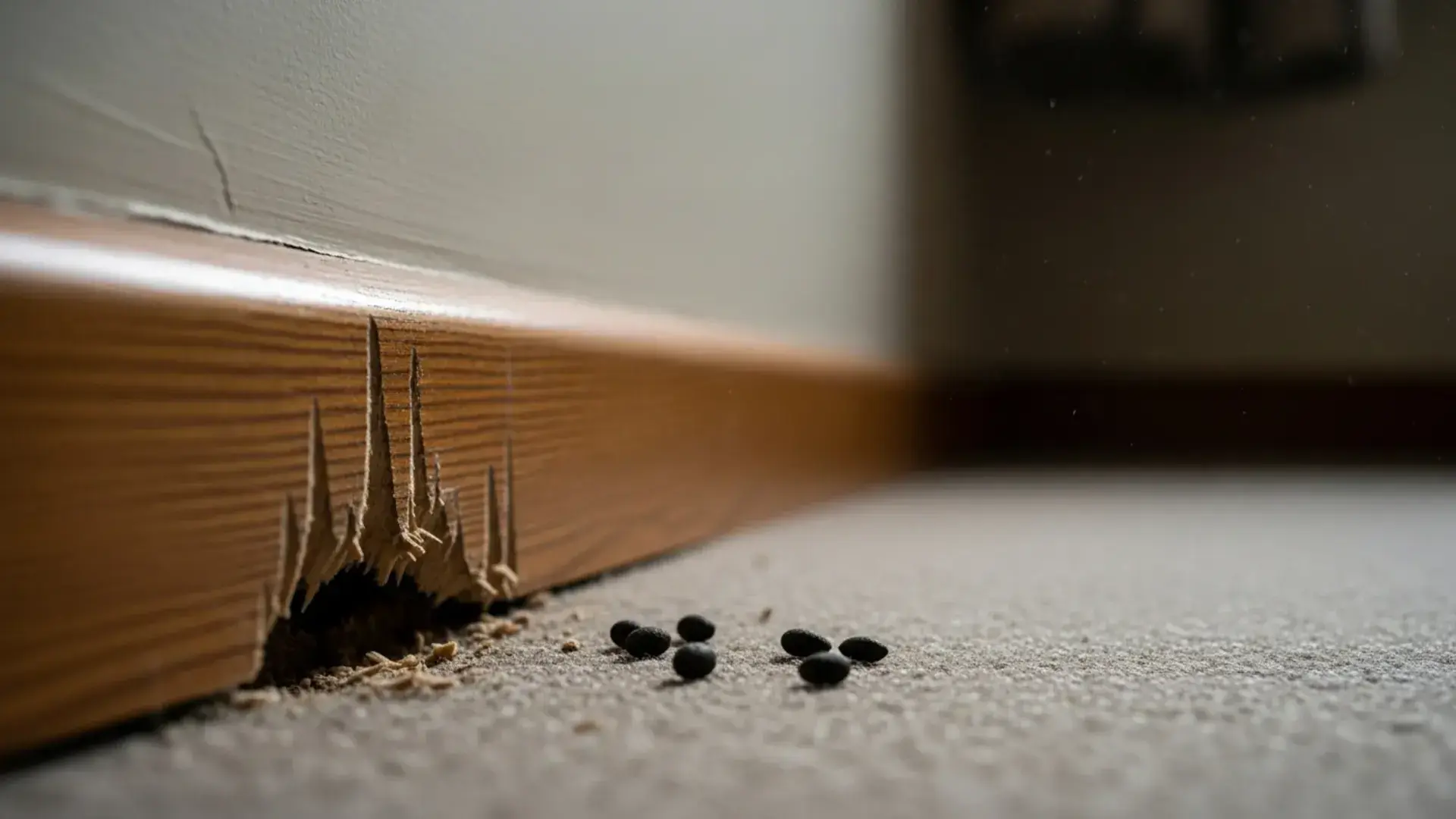
- Droppings: Found along travel routes, near food sources, and in sheltered areas. The size, shape, and freshness of droppings help identify the species and whether the infestation is active.
- Gnaw marks: Damage to cables, woodwork, food packaging, and pipework. Rodent incisors grow continuously, driving constant gnawing behaviour.
- Scratching and scurrying sounds: Particularly noticeable at night. Sounds in walls, lofts, and ceiling voids are often the first sign of a problem.
- Greasy rub marks: Dark smear marks along skirting boards, walls, and around entry points where rodents follow regular routes.
- Ammonia smell: A strong, musty odour from rodent urine, particularly noticeable in enclosed or poorly ventilated spaces.
- Nesting material: Shredded paper, insulation, fabric, and other soft materials gathered in hidden areas.
Different rodent species leave distinct evidence. For detailed identification guides, including droppings comparison, behaviour patterns, and diagnostic photographs, see our rat control and mouse control pages. If you are unsure what you are dealing with, our technicians will identify the species during the survey visit.
When Are Rodent Problems Most Common?
Autumn and winter are the peak period for rodent call-outs across the North East, as rats and mice move indoors seeking warmth, food, and shelter.
Rodent activity follows seasonal patterns driven by weather, food availability, and breeding cycles. Understanding when problems are most likely helps businesses and homeowners take preventative action at the right time.
Across the North East, rodent call-outs peak in autumn and winter. As temperatures drop from September onwards, rats and mice move towards heated buildings, seeking warmth, food, and shelter. Properties near farmland, watercourses, and commercial waste areas are particularly vulnerable during this period. By mid-winter, established populations that entered in autumn are breeding indoors, and noise complaints from loft and wall activity increase significantly.
Spring brings different pressures. Grey squirrels become active in loft spaces during their breeding season, and outdoor rat populations begin expanding as food sources increase. Summer sees the fastest outdoor breeding rates, with rat and mouse populations building numbers that will drive the next autumn migration indoors.
For detailed seasonal activity calendars and species-specific guidance, see our rat control, mouse control, and squirrel control pages. Businesses in Darlington, Durham, Middlesbrough, and across the North East can arrange preventative visits ahead of peak season to reduce the risk of infestation.
Legislation and Legal Duties
The Prevention of Damage by Pests Act 1949 places a legal duty on property owners and occupiers to keep land and buildings free from rodents. Failure to comply can result in enforcement action.
Property owners and occupiers have legal obligations to control rodent populations. The key legislation affecting rodent control includes:
- Prevention of Damage by Pests Act 1949: Places a duty on property owners and local authorities to keep land free from rats and mice. Local authorities can serve notice requiring action, and failure to comply can result in the authority carrying out the work and recovering costs.
- Health and Safety at Work Act 1974: Employers must ensure the workplace is safe and free from health hazards, including pest contamination.
- Food Safety Regulations 1995: Food businesses must prevent contamination from pests. A rodent sighting during an Environmental Health inspection can result in enforcement action, improvement notices, or closure.
- COSHH Regulations: Rodenticide use must follow strict handling, storage, and disposal procedures. All our treatments are CRRU-compliant.
For businesses in regulated sectors such as hospitality, healthcare, and education, maintaining a pest management programme with audit-ready documentation is essential for ongoing compliance.
Commercial and Domestic Rodent Management
Commercial rodent management programmes include scheduled visits, monitoring stations, and audit-ready documentation for BRC, SALSA, Red Tractor, and EHO compliance.
We provide rodent control for businesses and homes of all sizes across the North East. While the underlying pest biology is the same, commercial and domestic situations require different approaches.
Commercial premises: Businesses need proactive management, not reactive call-outs. Our commercial programmes include scheduled preventative visits, tamper-proof monitoring stations, digital reporting through our online portal, and full compliance documentation. We work with food manufacturers and retailers, hotels and restaurants, healthcare facilities, warehouses and distribution centres, rental and managed properties, and schools and universities.
Domestic properties: Most residential rodent problems can be resolved with a targeted treatment programme followed by proofing to prevent re-entry. Where rats are involved, we recommend a CCTV drain survey to check for defective drainage, which is one of the most common access routes into homes.
We cover Darlington, Stockton, Middlesbrough, Hartlepool, Durham, Sunderland, Newcastle, and the wider North East.
Prevention Tips
Proofing is the single most cost-effective long-term investment for rodent prevention. Sealing entry points stops new animals from following the same routes inside.
Preventing rodent problems is always more cost-effective than treating them. Key steps for businesses and homeowners include:
- Seal entry points: Close gaps around pipework, cables, vents, and where services enter the building. Rodents can squeeze through surprisingly small openings. Use steel wool, cement, or metal mesh rather than expanding foam, which rodents can gnaw through. For a thorough job, consider our professional rodent proofing service.
- Manage waste: Keep bins closed with tight-fitting lids. Do not leave food waste in open bags. Clear fallen fruit, bird feed, and pet food from outdoor areas.
- Maintain drains: Defective drains are one of the most common access routes for rodents into properties. A CCTV drain survey identifies defects and allows targeted repair.
- Reduce harbourage: Clear overgrown vegetation, stored materials, and debris from around buildings. Rodents use ground cover to approach buildings undetected.
- Regular inspections: Check loft spaces, under-floor areas, and around the exterior of buildings periodically for signs of rodent activity. Early detection prevents costly infestations.
For businesses in Darlington, Durham, Sunderland, and across the North East, we provide free site surveys to assess your property and recommend the most effective prevention measures.
Our Rodent Control Process
A structured, three-stage approach that treats the problem and prevents it returning.
Step 1
Inspect and Plan
A detailed property inspection identifies entry points, infestation hotspots, and the species involved. A targeted treatment plan is developed based on findings.
Step 2
Treatment
Professional control measures are applied using advanced techniques and CRRU-compliant products. Proofing and sealing work addresses the root cause at the same time.
Step 3
Ongoing Support
Follow-up visits confirm the problem is resolved. You receive clear documentation, prevention advice, and recommendations for ongoing protection.
Why Choose Us for Rodent Control
NPTA Member
Our technicians hold full NPTA membership, ensuring treatments meet the highest professional standards and are fully insured.
Same-Day Emergency Response
Urgent rodent problems receive priority. We offer same-day call-outs across the North East for both businesses and homeowners.
CRRU-Compliant Treatments
All rodenticide use follows Campaign for Responsible Rodenticide Use standards for safety, environmental responsibility, and protection of non-target wildlife.
Full Proofing and Prevention
We do not just treat the symptoms. Entry points are identified and sealed with our rodent proofing service to prevent re-infestation.
Drain and Sewer Solutions
Defective drains are one of the most common access routes for rodents into properties. Our CCTV drain surveys identify the source and allow permanent repair.
Commercial and Domestic
From multi-site commercial contracts with scheduled visits and compliance documentation to single homes, we manage rodent problems at any scale across Darlington, Stockton, Middlesbrough, Durham, Newcastle, and the wider North East.
"Brilliant service every time! Always very helpful. Thank you."
Ava Wilkinson · Google review, March 2026
NPTA Member
We are full members of the National Pest Technicians Association (NPTA). This means our technicians meet strict training and competency standards, carry appropriate insurance, and follow the association's code of practice. NPTA membership is your assurance that the work is carried out professionally and responsibly.
Fair, Transparent Pricing
Every job is different. The cost depends on the type of pest, scale of the problem, and what treatment is needed. We provide a free assessment and an honest quotation before any work begins. No hidden costs, no surprises.
View our pricing guideSatisfaction Guaranteed
If rodent activity returns within the agreed treatment period, we return and resolve the problem at no extra cost. All proofing work is guaranteed for materials and installation. Our commitment is to deliver a lasting solution, not a temporary fix.
Frequently Asked Questions
Common signs include droppings, gnaw marks on cables or woodwork, scratching or scurrying noises in walls or lofts (especially at night), greasy rub marks along skirting boards, and a strong musty ammonia-like smell. If you notice any of these signs, contact us for a free assessment.
We offer same-day emergency response across the North East for urgent rodent problems. For routine enquiries, we typically arrange a survey visit within 24 to 48 hours.
Yes. We use tamper-proof bait stations and targeted treatment methods that minimise risk to non-target animals, children, and pets. All rodenticide use follows CRRU standards. Our technicians will explain all safety precautions during the visit.
A one-off treatment addresses an active infestation with follow-up visits to confirm the problem is resolved. A pest management contract provides scheduled preventative visits throughout the year, monitoring for early signs of activity and maintaining proofing measures. Contracts are recommended for businesses that need to maintain audit readiness.
Our Other Services
Areas We Cover
We provide rodent control services across the North East of England.
Ready to talk to us?
Free survey and quotation for businesses and homeowners. No obligation, no pressure.
We will get back to you as soon as we can.