
Rodent Proofing
Survey-led rodent proofing for businesses and homes across the North East. Physical barriers that stop rats and mice entering your property permanently.
Why You Need Professional Rodent Proofing
Rodent proofing is the most effective long-term solution to rodent problems. Rather than treating infestations after they develop, proofing eliminates entry points permanently using professional-grade physical barriers. We survey your property, identify every potential access route, and install materials that rats and mice cannot gnaw through, burrow under, or squeeze past. No chemicals, no toxicants, and no vacate period required.
What's Included
Why acting quickly matters
Around 30 percent of rodent infestations in commercial premises originate from loading areas. A single gap of 20mm (the size of a 20 pence coin) is enough for a rat to enter, and mice can squeeze through gaps as small as 6mm. Every unsealed entry point is a route that rodents will find and exploit, often within days of an active population establishing nearby.
Need your property proofed against rodents?
Free survey and quotation for businesses and homeowners across the North East. No chemicals, no disruption.
Request a free call back
Prefer to get in touch another way? Contact us or email info@wynyardpestcontrol.co.uk
Related Services
"[The technician] was fantastic highly recommend"
Nicola Sewell · Google review, April 2026
Ready to stop rodents getting in?
Free proofing survey and quotation for businesses and homeowners. Professional-grade barriers installed with guaranteed workmanship.
Why Rodent Proofing Works
Physical proofing provides impenetrable barriers that eliminate entry points permanently, reducing the need for rodenticides and supporting CRRU compliance.
Traditional rodent control focuses on treating infestations after they have established. Rodent proofing takes a fundamentally different approach: it prevents rodents from entering in the first place.
Proofing works because it addresses the root cause of every infestation, which is access. No matter how effective a treatment programme is, if entry points remain open, new rodents will follow the same routes inside. Treatment without proofing is a cycle of re-infestation that never ends.
Physical barriers made from stainless steel mesh, Kevlar-reinforced materials, and hardwearing rubber extrusions are materials that rats and mice cannot gnaw through. Unlike expanding foam, silicone sealant, or wood, which rodents destroy within hours, professional proofing materials are permanent.
This sustainable approach supports UK legislation around food safety, health and safety, and CRRU (Campaign for Responsible Rodenticide Use) regulations. By reducing reliance on rodenticides, proofing also protects non-target wildlife including birds of prey and mammals that are vulnerable to secondary poisoning.
For businesses under audit from BRC, HACCP, or Environmental Health, proofing provides documented evidence of a proactive, prevention-first approach to pest management. For homeowners dealing with recurring rodent problems, it stops the cycle permanently.
How the Service Works
Most proofing jobs are completed in two visits: a survey and quote, followed by installation. Straightforward jobs such as a single door seal can be completed in one visit.
Rodent proofing is a survey-led installation service. The process typically runs over two visits.
Survey visit (Day 1, 45 to 90 minutes): A full inspection of the building perimeter, loading areas, drains, doors, expansion joints, weep vents, and cable and pipework penetrations. All entry risks are identified and photographed. You receive a written proofing report and itemised quotation.
Installation visit (following survey, once approved): Physical proofing materials are installed at all identified entry points. Dock leveller seals, door brush strips, mesh, expansion joint fill, weep vent covers, and ground mesh are fitted as required. Duration varies by scope, typically 1 to 8 hours. A completion report is issued on the day.
Some straightforward jobs, such as a single door seal or weep vent proofing, can be completed in a single visit.
No chemicals or toxicants are involved in rodent proofing. There is no vacate period required. All proofing work uses mechanical and physical barriers only, making it fully safe for all occupants, children, pets, and food production environments throughout the process.
Common Rodent Entry Points
Rodents exploit surprisingly small gaps to enter buildings. A rat can squeeze through a hole as small as 20mm (the size of a 20 pence coin), and a mouse can pass through a gap of just 6mm (roughly the width of a pencil). Identifying every potential entry point is the foundation of effective proofing.
Commercial premises:
- Loading docks and dock levellers: Around 30 percent of rodent infestations in commercial premises originate from loading areas. Gaps around dock levellers, roller shutters, and loading bay doors provide easy access.
- Expansion joints: Gaps in concrete floors designed to accommodate thermal movement. Rodents use these as concealed highways to travel through buildings undetected.
- Cladding gaps: The space between external cladding and brickwork on industrial and commercial buildings is a common entry route that is often overlooked.
- Cable and pipework penetrations: Holes drilled for utility services are frequently left unsealed or poorly filled with materials rodents can gnaw through.
Residential properties:
- Weep vents and air bricks: Designed for ventilation and drainage in brickwork, but provide direct access to wall cavities. Once inside a cavity, rodents can travel throughout the building undetected.
- Door gaps: Gaps beneath external doors, garage doors, and internal doors connecting to garages or utility areas.
- Roof and soffit gaps: Damaged tiles, gaps under eaves, and openings around roof vents.
- Drains: Broken or displaced drain connections are one of the most common entry routes for rats. Our drain and sewer solutions service addresses this specifically.
During the survey visit, we inspect every one of these areas and document all risks with photographs before recommending proofing measures.
Dock Leveller Proofing
Dock levellers are a major entry point for rodents in warehousing, supermarkets, distribution centres, and any premises with loading areas. Data shows around 30 percent of rodent infestations in these environments originate from loading areas where gaps around dock levellers provide direct access.
Our dock leveller proofing uses a combination of Kevlar and knitted steel mesh that is flexible enough to accommodate variations in dock leveller size, height, and movement while remaining completely impenetrable to rodent gnawing. The material flexes with the dock leveller as it operates, maintaining a continuous seal.
Beyond rodent exclusion, dock leveller proofing also acts as a barrier to dirt, debris, wind, and rain. It helps reduce light ingress, odour transfer, and energy loss from temperature-controlled environments, which can be a significant benefit for food storage and distribution facilities.
This proofing is particularly important for businesses subject to BRC, HACCP, or other food safety audits where evidence of physical rodent exclusion at loading areas is expected.
Expansion Joint Proofing
Expansion joints are gaps built into concrete floors and walls to allow for thermal expansion and contraction. While structurally necessary, these gaps provide rodents with concealed highways to travel unnoticed through buildings.
Our expansion joint proofing uses resilient, flexible knitted stainless steel mesh combined with a self-levelling epoxy compound. This fills the joint completely while still allowing it to flex normally with temperature changes. The result is a permanent barrier that rodents cannot penetrate, without compromising the structural function of the joint.
This proofing is particularly relevant for warehouses, food production plants, supermarkets, factories, retail premises, and distribution centres where large floor areas with multiple expansion joints create numerous potential entry routes.
Why Choose Us for Rodent Proofing
100% Chemical-Free
Rodent proofing uses only physical barriers. No rodenticides, no toxicants, and no risk to children, pets, or non-target wildlife. Safe for food production environments throughout the process.
Professional-Grade Materials
We use stainless steel knitted mesh, Kevlar-reinforced barriers, and hardwearing rubber extrusions that rodents cannot gnaw through. These are commercial-specification products, not hardware shop alternatives.
Guaranteed Workmanship
Every proofing installation is backed by our workmanship guarantee. If rodents breach a barrier we installed, we return and fix it at no extra cost.
Survey-Led Approach
Every job starts with a detailed inspection of the full building perimeter. We identify, photograph, and document all entry risks before providing an itemised quotation. No guesswork.
Complements Pest Contracts
Proofing works alongside ongoing pest management contracts. By closing physical entry routes, proofing reduces bait consumption, call-out frequency, and long-term costs.
Commercial and Domestic Expertise
From warehouse loading docks and food production facilities to residential lofts and garden sheds, we proof properties of all types and sizes across the North East.
Weep Vent and Air Brick Proofing
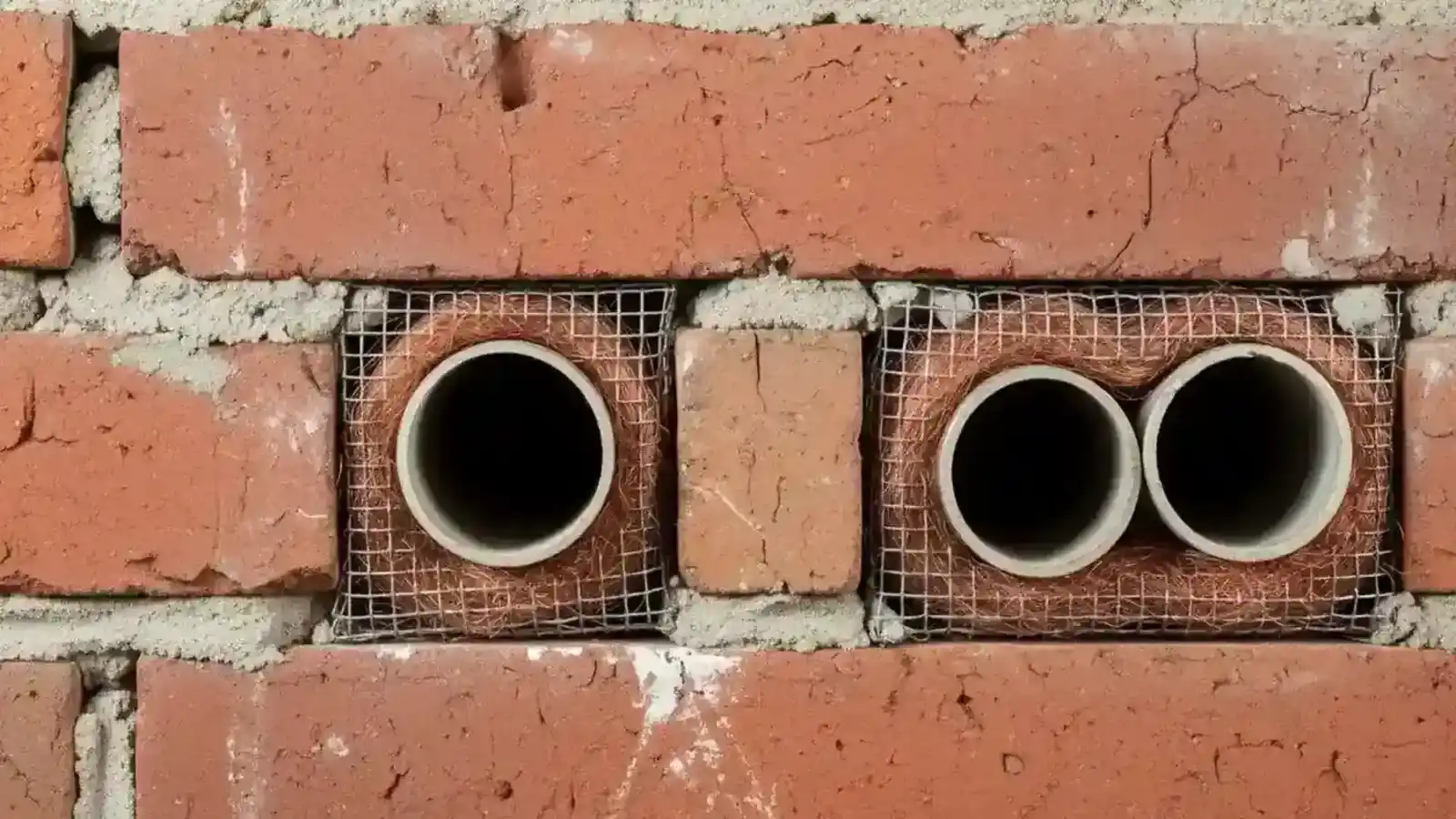
Weep holes and air bricks in brickwork serve essential purposes: weep vents allow moisture to drain from behind the outer leaf of masonry, and air bricks provide ventilation to sub-floor spaces. However, both provide direct access to wall cavities, and once a rodent enters a cavity, it can travel throughout a building undetected.
Our weep vent proofing uses breathable yet sturdy stainless steel knitted mesh that seals the opening without impeding drainage or natural ventilation. The mesh can be fitted to weep vents of any size without damaging the surrounding brickwork and mortar.
Air brick covers use a similar approach, with galvanised wire mesh fitted over the air brick to maintain airflow while creating an impenetrable barrier to rodents and insects.
This proofing is important for both commercial and domestic properties. In homes, unsealed weep vents are one of the most common routes for mice to enter wall cavities, leading to scratching noises, droppings in loft spaces, and contamination of stored items.
Door and Roller Shutter Proofing
Gaps beneath and around doors are one of the simplest entry points for rodents to exploit. External doors, garage doors, roller shutters, and insulated loading doors all develop gaps through wear, settlement, and damage over time.
Our door proofing uses hardwearing rubber extrusion with a knitted steel mesh core. This provides a 100 percent seal against rodent intrusion while withstanding the repeated impact of daily door use. The material is abrasion tested and lasts over twice as long as equivalent competitor products.
We supply and install proofing for:
- Pedestrian doors: Brush strips and rubber seals fitted to the bottom and sides of external doors
- Roller shutter doors: Flexible seals that maintain contact with the floor across the full width of the shutter
- Insulated loading doors: Heavy-duty seals designed for high-traffic commercial environments
- Door side seals: Closing gaps between loading door frames and walls where rodents access from the sides
For commercial premises, particularly those in the food and industrial sectors, door proofing is a critical element of any pest management programme.
Ground Mesh and Perimeter Proofing
Rats are prolific burrowers. Brown rats dig extensive burrow systems near foundations, under sheds, beneath decking, and along building perimeters. Burrowing creates harbourage sites close to buildings and can undermine structural integrity over time.
Ground mesh is a highly corrosion-resistant, flexible, and sturdy covering installed at ground level around the perimeter of buildings. It prevents burrowing pests from creating underground dens and harbourage sites close to facilities.
This proofing is particularly effective for:
- Warehouse and factory perimeters where burrow activity is common
- Properties adjacent to farmland, waterways, or waste ground
- Buildings with shallow foundations or raised floor voids
- Sites where outdoor bait stations are attracting rodent activity near building edges
Ground mesh can be installed as a standalone measure or as part of a comprehensive perimeter proofing programme that also addresses doors, vents, and cladding gaps.
Building Seal Mesh for Cladded Buildings
Cladded buildings, including warehouses, factories, retail units, and modern commercial premises, frequently have gaps between the external cladding and the underlying brickwork or blockwork. These gaps are often invisible from the outside but provide an easy entry route for rodents.
Building seal mesh is galvanised stainless steel knitted mesh installed around the full perimeter of cladded buildings to create an impenetrable barrier at the junction between cladding and masonry. The mesh is flexible enough to follow the contours of the building while remaining rigid enough to resist rodent gnawing.
This proofing is essential for industrial and commercial properties where the cladding-to-masonry junction has not been adequately sealed during construction, or where original seals have deteriorated with age. It is a common requirement identified during pest management audits and Environmental Health inspections.
Our Rodent Proofing Process
A structured, three-stage approach that treats the problem and prevents it returning.
Step 1
Inspect and Plan
A detailed property inspection identifies entry points, infestation hotspots, and the species involved. A targeted treatment plan is developed based on findings.
Step 2
Treatment
Professional control measures are applied using advanced techniques and CRRU-compliant products. Proofing and sealing work addresses the root cause at the same time.
Step 3
Ongoing Support
Follow-up visits confirm the problem is resolved. You receive clear documentation, prevention advice, and recommendations for ongoing protection.
Ready to stop rodents getting in?
Free proofing survey and quotation for businesses and homeowners. Professional-grade barriers installed with guaranteed workmanship.
Commercial vs Residential Proofing
Businesses under BRC, HACCP, or Environmental Health audit are expected to demonstrate proactive physical exclusion measures, not just reactive treatment.
The scope and specification of rodent proofing differs significantly between commercial and residential properties.
For businesses: Commercial proofing centres on compliance, risk mitigation, and asset protection. Food premises (restaurants, cafes, hotels, food processing facilities, and supermarkets) face statutory obligations under food safety and hygiene regulations. A rodent sighting during an Environmental Health Officer inspection can result in closure notices, improvement orders, and lasting reputational damage.
Commercial proofing typically covers larger areas and requires industrial-specification materials: dock leveller seals, expansion joint fills, building seal mesh, and heavy-duty door proofing designed for high-traffic environments. All work is documented with photographs and completion reports that support audit compliance.
Healthcare facilities, care homes, schools, and rental properties all have specific regulatory requirements around pest prevention that proofing directly supports.
For homes: Residential proofing focuses on the most common domestic entry points: weep vents, air bricks, door gaps, roofline openings, and gaps around utility penetrations. The materials are the same professional-grade specification, but the scope is typically smaller and the work can often be completed in a single visit.
For homeowners dealing with recurring rat or mouse problems, proofing is the single most effective step to stop the cycle. Treatment removes the current population; proofing prevents the next one. We carry out domestic and commercial proofing across the North East, including Durham, Middlesbrough, Sunderland, and surrounding areas.
Proofing as Part of Integrated Pest Management
Rodent proofing is most effective when it forms part of an integrated pest management (IPM) approach. IPM combines physical exclusion, environmental management, monitoring, and targeted treatment to deliver long-term control rather than short-term fixes.
For businesses with ongoing pest management contracts, adding proofing delivers measurable benefits:
- Reduced bait consumption: Fewer rodents entering the building means less rodenticide needed, supporting CRRU compliance and reducing environmental impact
- Fewer emergency call-outs: Proofing addresses root causes, reducing the frequency of reactive visits
- Lower long-term costs: The upfront investment in proofing is typically recovered within 12 to 18 months through reduced treatment costs
- Stronger audit outcomes: Documented proofing demonstrates a proactive approach that auditors and regulators expect to see
We work with existing pest management contracts to identify where proofing will have the greatest impact. For new clients, we can provide proofing as a standalone service or as part of a combined treatment and prevention programme.
For properties where drain and sewer access is a contributing factor, combining proofing with drain surveys and rat blocker installation closes the two most common entry routes simultaneously.
Bait-Free and Chemical-Free Alternatives
Many customers, particularly homeowners with children and pets, are reluctant to use rodenticides. Rodent proofing itself is entirely chemical-free, but where active control is also needed, there are bait-free alternatives that can complement a proofing programme.
No single alternative method is guaranteed to eliminate an established infestation. Every approach must be backed up with prevention measures to deny rats and mice access to food and shelter.
Spring and snap traps: Designed to kill rodents with a spring release mechanism. Advantages over rodenticides for small infestations in homes and garages include avoiding toxic chemicals, being reasonably cheap and reusable, allowing confirmation that a rodent has been caught, and preventing decomposition smells in inaccessible spaces. Place traps along rat or mouse runs, usually along walls, with the trigger side flush against the wall. Traps must be checked frequently to remove dead animals and humanely deal with any caught alive.
Bait selection and bait shyness: Rodent traps require food bait to attract the target. Rodents have poor eyesight but a highly developed sense of taste and smell. They prefer cereal grains, meat, fish, nuts, peanut butter, and chocolate spread. Bait that is difficult for rodents to remove (such as peanut butter) tends to be more successful. Rats are neophobic (cautious of new objects) and will initially avoid anything new in their environment. Placing traps with food but not setting the trigger for a few days helps overcome trap and bait shyness.
Ultrasonic repellents (not effective): Many electronic devices claim to repel rodents using ultrasound. However, ultrasound dissipates quickly with distance and is blocked by objects. There is only limited evidence of short-term effect in very small spaces. Rodents quickly become accustomed to the sound, and their need for food and shelter will always overpower any noise disturbance. Ultrasonic repellents are not a reliable solution for established infestations.
Scent repellents (not effective): Rodents may find some smells temporarily unpleasant, such as ammonia, mothballs, peppermint oil, and eucalyptus. However, none are effective long-term repellents. Scents fade quickly and are easily ignored when a food source is present. Professional exclusion, proofing, and sanitation remain the only reliable long-term approaches.
DIY vs Professional Proofing
DIY proofing has a place for minor, visible gaps, but it has significant limitations when it comes to permanent rodent exclusion.
Common DIY materials and their limitations:
- Expanding foam: Rats gnaw through expanding foam within hours. It is not a rodent-proof material under any circumstances.
- Wire wool (steel wool): Effective as a temporary gap filler when packed tightly into holes, but it corrodes over time and can be pulled out by persistent rodents. Best used as an interim measure before professional proofing.
- Silicone sealant: Rodents gnaw through standard silicone easily. It is not suitable as a standalone proofing material.
- Cement and mortar: Effective for sealing gaps in masonry when applied correctly, but requires the right specification and application technique to resist gnawing.
When DIY is reasonable: Packing steel wool tightly into a visible gap as a temporary fix while waiting for a professional survey. Fitting a commercially available air brick cover over an exposed vent.
When you need professional proofing: Recurring rodent problems despite previous treatment. Multiple entry points across the property. Commercial premises requiring audit-compliant documentation. Loading areas, expansion joints, or cladding gaps that require specialist materials and installation techniques.
When to Arrange Proofing
Summer is the ideal time to arrange proofing before the autumn ingress, when dropping temperatures drive rodents to seek warmth and shelter inside buildings.
Rodent proofing can be carried out at any time of year, but timing it well maximises its impact.
After treatment: The most common time to arrange proofing is immediately after a rat or mouse treatment programme. Once the existing infestation has been resolved, proofing closes the entry points that allowed rodents in, preventing re-infestation.
Before autumn (June to August): The autumn ingress, when rodents move indoors as temperatures drop, is the peak period for new infestations across the North East. Properties near farmland, waterways, and older drainage systems in areas such as Darlington, Stockton, and Hartlepool are particularly vulnerable. Proofing in summer seals entry points before the pressure increases.
New builds and renovations: Proofing is far easier and more cost-effective to install during construction or renovation than after the fact. We work with builders and property developers to integrate proofing into the build programme.
As part of a new pest contract: When businesses set up new pest management contracts, adding a proofing survey at the outset identifies physical improvements that reduce the ongoing cost and frequency of reactive visits.
After a failed DIY attempt: If you have attempted to seal entry points yourself but rodent activity has returned, a professional survey will identify the gaps that were missed and the materials that failed.
"Great and knowledgable service, very tidy and punctual. Would happily recommend [the technician] to anyone"
Luke Jackson · Google review, April 2026
NPTA Member
We are full members of the National Pest Technicians Association (NPTA). This means our technicians meet strict training and competency standards, carry appropriate insurance, and follow the association's code of practice. NPTA membership is your assurance that the work is carried out professionally and responsibly.
Fair, Transparent Pricing
Every job is different. The cost depends on the type of pest, scale of the problem, and what treatment is needed. We provide a free assessment and an honest quotation before any work begins. No hidden costs, no surprises.
View our pricing guideSatisfaction Guaranteed
Every proofing installation is backed by our workmanship guarantee. We survey your property, identify and document all entry points, and install professional-grade barriers designed to last. If rodents breach a barrier we installed, we return and fix it at no extra cost.
Frequently Asked Questions
Most jobs involve two visits: a survey (45 to 90 minutes) followed by an installation visit (1 to 8 hours depending on scope). Straightforward jobs such as a single door seal or weep vent proofing can be completed in a single visit.
We use professional-grade stainless steel knitted mesh, Kevlar-reinforced barriers, galvanised wire mesh, hardwearing rubber extrusions with steel mesh cores, and self-levelling epoxy compounds. These are commercial-specification materials that rodents cannot gnaw through.
Yes. Rodent proofing is 100 percent chemical-free. No rodenticides, toxicants, or hazardous substances are used at any stage. There is no vacate period required. The work is fully safe for all occupants, including in food production environments.
Yes. We proof commercial warehouses, factories, food production facilities, retail units, offices, residential houses, flats, and outbuildings. The materials and techniques are adapted to each building type, from dock leveller seals on loading bays to weep vent mesh on domestic brickwork.
Proofing addresses all identified physical entry points. Combined with drain solutions where needed, it closes the vast majority of access routes. Our workmanship guarantee covers any breach of a barrier we installed.
For commercial premises, we recommend maintaining a pest management contract alongside proofing. The contract provides monitoring, documentation for audits, and rapid response if new issues arise. For homes, proofing alone may be sufficient to prevent future problems. In both cases, proofing significantly reduces the frequency and cost of reactive visits.
Minor, visible gaps can be temporarily filled with tightly packed steel wool as an interim measure. However, most rodent entry points are difficult to identify without professional experience, and hardware shop materials such as expanding foam and silicone are not rodent-proof. A professional survey identifies all entry points, and commercial-grade materials provide permanent barriers.
Yes. Every proofing installation is backed by our workmanship guarantee. If rodents breach a barrier we installed, we return and fix it at no extra cost.
Related Services
Our Other Services
Areas We Cover
We provide rodent proofing services across the North East of England.
Ready to talk to us?
Free survey and quotation for businesses and homeowners. No obligation, no pressure.
We will get back to you as soon as we can.