
Fly Control
Professional fly control for businesses and homes across the North East. Species-specific treatments for house flies, cluster flies, fruit flies, drain flies, and bluebottles. Lumnia LED fly killers, EcoCatch traps, fly screens, and scheduled servicing contracts.
Why You Need Professional Fly Control
There are over 120,000 species of flies globally. Flies are often unwelcome due to the health risks they pose to people, pets, and livestock. They are carriers of food poisoning, dysentery, and diarrhoea, contaminating homes and businesses with diseases like Salmonella and E. coli. Some fly species can also bite, such as the horse fly. Combating fly infestations requires a tailored approach, ranging from common fly sprays to advanced solutions like external fly traps and LED fly killers. For businesses, understanding the seasonal impact of fly populations is important. A comprehensive fly control programme should exclude, restrict, destroy, and monitor fly infestations.
What's Included
Why acting quickly matters
On average, the adult house fly lives for around 30 days. Female fruit flies breed up to 500 eggs at a time, which can fully develop in as little as 7 days. A small fly problem can escalate into a major infestation within weeks if the breeding source is not identified and eliminated.
Fly Problem Getting Worse?
Same-day response for homes and businesses across the North East. Free survey and quotation, including species identification.
Request a free call back
Prefer to get in touch another way? Contact us or email info@wynyardpestcontrol.co.uk
Threat Assessment
Nuisance:
7/10HIGHFlies are a constant nuisance in warmer months, contaminating food and surfaces wherever they land. Cluster flies can invade loft spaces in their thousands during autumn. Fruit flies breed rapidly in kitchens, bars, and food preparation areas.
Hazard:
7/10HIGHHouse flies carry and transmit pathogens including Salmonella, E. coli, and dysentery. They breed in decaying matter and faeces, transferring bacteria to food and clean surfaces via their legs and bodies. Horse fly bites are painful and can cause allergic reactions.
Vital Statistics
| Common species (UK) | House Fly, Cluster Fly, Fruit Fly, Bluebottle, Drain Fly, Horse Fly |
| House fly size | 5 to 8 mm |
| House fly lifespan | Around 30 days |
| Lifecycle | Egg, larva, pupa, adult (complete metamorphosis) |
| Fruit fly eggs per batch | Up to 500 |
| Fruit fly development | As little as 7 days from egg to adult |
| Cluster fly behaviour | Overwinters in lofts and wall voids (autumn to spring) |
| Disease transmission | Salmonella, E. coli, dysentery, food poisoning |
| Horse fly bite | Painful scissor-like mouthparts that slash skin |
| Active period | Year round indoors, peak May to October |
Key Facts
- House flies are major carriers of disease, transferring bacteria from decaying matter and faeces onto food and surfaces via their legs, wings, and bodies
- Fruit flies breed up to 500 eggs at a time and can complete their development in as little as 7 days, leading to rapid infestation in kitchens, bars, and food areas
- Horse flies have scissor-like mouthparts that slash open skin, causing painful bites that can trigger allergic reactions in some people
- Whatever surfaces flies visit and crawl on, bacteria can stick to their bodies, especially their legs and wings, and then be deposited on food and clean surfaces
- Cluster flies enter buildings in autumn to hibernate in loft spaces, roof voids, and wall cavities, often in very large numbers. They reappear in spring as temperatures rise
- Cluster flies are not considered a health risk. They are parasitic on earthworms and do not breed in or contaminate human food
- The European RoSH Directive is phasing out fluorescent UV tubes used in traditional electric fly killers due to mercury content. The exemption is due to end from February 2027
- Lumnia LED fly control units use up to 79% less energy than conventional insect light traps and produce 62% lower carbon emissions
"[The technician] gave me great advice regarding some fleas. Would recommend."
Hannah SCOTT · Google review, March 2026
Fly Problem at Home or Work?
Whether it is cluster flies in your loft, fruit flies in your kitchen, or a commercial fly management requirement, contact us for expert identification and targeted treatment.
Signs of a Fly Infestation
Noticing a few flies may not mean you have an infestation. However, it should act as a warning sign to take preventative action. Common signs include:
- Maggots: Flies in their larval stage, indicating a potential breeding site on your property. Check bins, drains, and any area where organic waste may accumulate
- Regular sighting of flies: Repeated sightings around your home, food preparation areas, or bins suggest a nearby breeding source rather than passing visitors
- Small dark clusters of spots: Found in light-coloured areas, roughly pinhead size. These are fly droppings and indicate regular fly activity in that location
If you spot any of these signs, DIY fly products like light traps can reduce the number of adult flies but cannot address a potential breeding site. Professional treatment of fly breeding sites is essential for long-term control.
ERDM Framework
Professional fly control follows the ERDM process to ensure the most effective results:
- Exclusion: Prevent flies from entering by proofing doors, windows, roof vents, and other entry points. This includes fly screen installation and sealing gaps in building fabric
- Restriction: Routine good housekeeping practices to remove potential fly breeding areas. Proper waste management, clean drains, and prompt removal of decaying organic matter
- Destruction: Correct identification of the specific fly species so the most effective control treatment is used. Different species require different approaches
- Monitoring: Regular inspections so any issues can be treated quickly before becoming an infestation. Includes catch tray analysis and trend reporting for commercial clients
Common Fly Species
House Fly (Musca domestica)
House flies are major carriers of disease and can infest all types of premises. They are attracted to all types of food, including human food, pet food, animal feed, food waste, and faeces.
- Size: Adult is 5 to 8 mm in length
- Appearance: Grey thorax with 4 narrow stripes, buff or yellow abdomen. Covered with small hairs that serve as taste organs
- Breeding: Eggs laid in batches of 120 to 150, hatching in 8 to 72 hours. Breeds in moist decaying vegetable matter such as uncovered bins or pet food
- Development: Larvae take 3 to 60 days to mature, pupae mature in 3 to 28 days
Bluebottle Fly (Calliphora vomitoria)
Bluebottle flies, also known as blow flies, can often be seen hovering around bins. These scavengers are attracted to pet faeces and dead animals and are known carriers of disease.
- Size: Adult is 6 to 12 mm in length
- Appearance: Metallic blue colour
- Breeding: Eggs hatch in 0 to 18 hours (partial development may occur within the female). Breeds mostly in meat-derived substances, sometimes cheese
- Development: Larvae take 7 to 12 days to mature
Fruit Fly (Drosophila species)
Fruit flies are commonly found infesting fruit or hovering around fermenting residues found in pubs, fruit orchards, vegetable plots, and breweries.
- Size: 3 mm in length
- Appearance: Yellow-brown or mottled in colour with bright red eyes. Abdomen hangs down in flight, which is slow with a tendency to hover
- Breeding: Females can lay up to 500 eggs at a time. Can breed in rotten fruit, unclean drains, and even cleaning utensils
- Development: Develops to adult in 7 to 30 days. In ideal conditions, can complete development in as little as 1 week. Adult lives 2 to 9 weeks
Filter Fly (Psychodidae)
Filter flies are often associated with sewage beds, where larvae feed on sludge-like organic matter. Also known as drain fly, sewage fly, or moth fly.
- Size: 2 mm in length
- Appearance: Tan-coloured body appears as grey. Wings densely covered in hair and held tent-like over the body when at rest
- Development: Eggs hatch in 1 to 6 days, larvae take 10 to 50 days to mature, pupae take 1 to 3 days
Horse Fly (Family Tabanidae)
Horse flies are a particular pest to livestock. Relentless biting attacks by females can result in reduced weight gain in some animals. Horse fly bites can be very painful for humans too. They have mouthparts that work like miniature knives, slashing open the skin with a scissor-like motion.
- Size: Adults can be up to 25 mm long
- Appearance: Black to dark brown in colour with green or black eyes. Males have contiguous eyes, females have widely separated eyes
- Breeding: Eggs laid in masses of 100 to 1,000 on vertical surfaces overhanging water or wet ground. Eggs hatch in 5 to 7 days, overwinter in larval stage
- Lifecycle: Adult life cycle is 30 to 60 days
Cluster Flies and Overwintering Insects
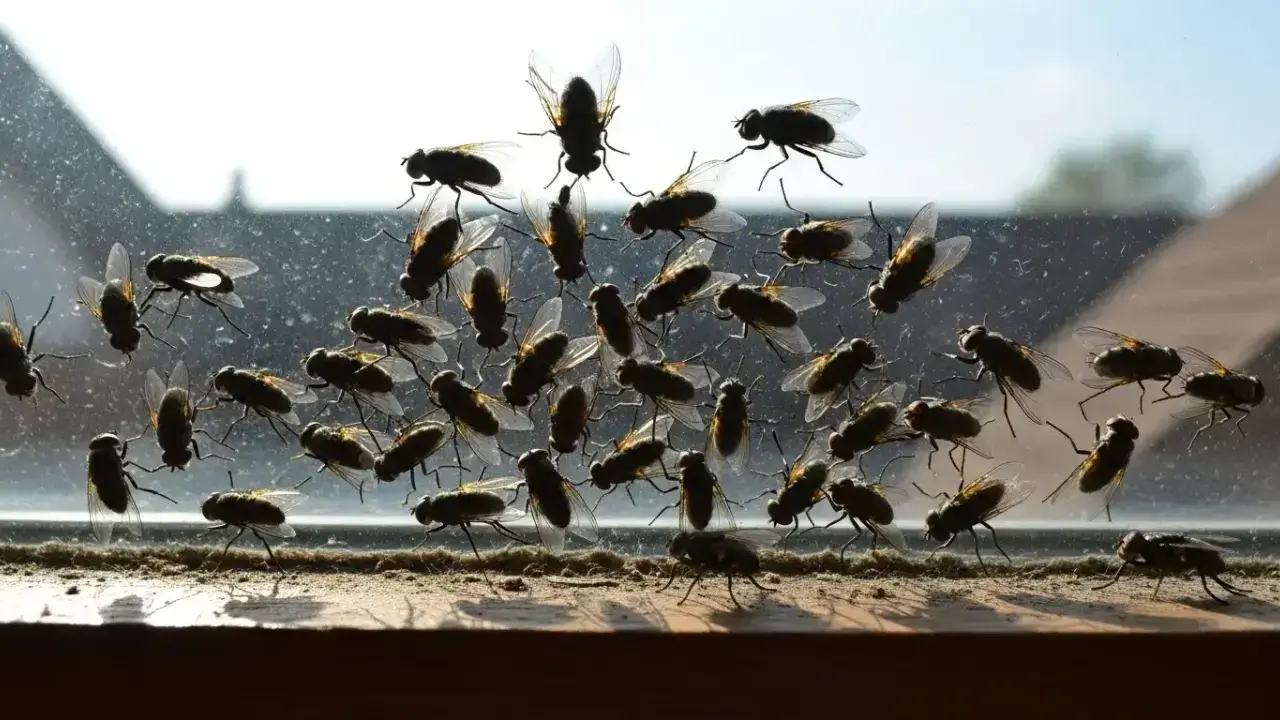
Cluster flies are a common and often misunderstood nuisance, particularly in rural and semi-rural properties. Unlike house flies, they do not breed indoors and are not attracted to food waste. Instead, they enter homes in autumn to hibernate in loft spaces, roof voids, and wall cavities, reappearing in spring as temperatures rise. Their presence is most noticeable twice a year: once on entry in autumn, and again when they emerge in spring.
Common Cluster Fly Species
- Cluster Fly (Pollenia rudis): The most widespread species. Dark grey with golden hairs on the thorax. Larvae feed on earthworms outdoors; adults move inside in autumn to hibernate in large numbers
- Yellow Swarming Fly (Thaumatomyia notata): Smaller with distinctive yellow markings. Can invade in very large numbers, often seen swarming around windows and sunny walls despite their small size
- Autumn Fly (Musca autumnalis): Very similar in appearance to the house fly. Found outdoors in summer feeding on livestock; gathers in buildings to overwinter as temperatures drop
- Green Cluster Fly (Dasyphora cyanella): A metallic green species occasionally mistaken for a blowfly. Less common than Pollenia rudis, but also seeks indoor shelter in the cold months
Other Overwintering Guests
Cluster flies are the main culprit, but other insects also overwinter in loft spaces. As temperatures drop, queen wasps and hornets crawl into attics and roof voids to lie dormant until spring. You may also find green lacewings gathering in surprisingly large clusters, and harlequin ladybirds grouping in window frames, rafters, and hidden cracks. If you find a mixture of different insects in your loft each winter, a professional inspection can confirm what you are dealing with and recommend the most effective treatment approach.
Cluster fly problems are particularly common in rural and semi-rural properties across Darlington, Durham, and Stockton, where proximity to farmland and grassland supports large earthworm populations that cluster flies depend on for breeding.
Cluster Fly Treatment
Low numbers of cluster flies can sometimes be managed with a vacuum or aerosol spray. For larger infestations in loft spaces and wall voids, professional residual insecticide treatment is the most effective approach. In properties where proofing is not feasible due to roof construction, an annual treatment programme is recommended. Consistent treatments reduce the population year on year, making infestations more manageable over time.
Fly Control for Businesses
Fly paper is not suitable for commercial kitchens. For food preparation areas, use adhesive encapsulation units (such as Lumnia) that contain insect fragments hygienically rather than allowing blow-out into the surrounding area.
Flies can spread diseases, contaminate food, and bite people. This can have serious consequences for businesses, giving a poor impression to customers and employees. Without effective fly control in food preparation and storage areas, flies could spread diseases and contaminate food. This can lead to loss of earnings, being shut down for non-compliance with legislation, and lasting reputation damage.
Electronic Fly Control Units
- Decorative units: For customer-facing areas, designed to blend into interiors including units styled to look like light fittings
- Slim units: Wall-mounted, ceiling-mounted, or free-standing options to suit different premises layouts
- Adhesive units: For sensitive areas where insect fragmentation (blow-out) must be avoided
- High-voltage units: For back-of-house and industrial environments where aesthetics are less important
- Planned servicing: Scheduled tube replacements, adhesive board changes, catch tray analysis, and trend reporting for audit documentation
Fly Screens and Physical Barriers
Many sites choose to fit insect screens on opening doors and windows as part of their hygiene and pest prevention controls. We supply and install insect-proof fly screens for windows and doors, made to measure to fit most door and window types. We also supply and install fly chains, fly screen curtains, and strip curtains.
Professional Fly Control Process
- Contact: Call and arrange for a local team visit at a time that suits your business
- Survey: A no-obligation site survey to assess the level of infestation and identify the invading fly species
- Treatment: NPTA-qualified technicians provide targeted treatments with regular follow-up visits
- Aftercare: Ongoing monitoring to ensure any new activity is resolved quickly
We deliver fly management programmes for healthcare facilities, schools, and industrial sites across Middlesbrough, Hartlepool, and Sunderland. Find out more about how we work with commercial clients.
Seasonal Fly Activity in the North East
Hover or tap a month to see Fly activity details
Minimal fly activity outdoors. Cluster flies dormant in lofts. Indoor fruit fly issues possible near drains and bins.
Flies remain mostly inactive outdoors. Cluster flies may appear at windows on sunny days.
Cluster flies begin emerging from hibernation. Early house fly activity as temperatures rise.
House fly and bluebottle activity increasing. Cluster flies leaving overwintering sites.
Fly breeding accelerates. House flies, bluebottles, and fruit flies becoming more prevalent.
Peak fly season begins. All common species active. Horse fly season starts.
Peak activity for house flies, fruit flies, and horse flies. Rapid breeding in warm conditions.
Continued peak activity. Outdoor dining and waste areas particularly affected.
Cluster flies begin seeking overwintering sites. House fly and fruit fly activity remains high.
Cluster flies entering lofts and wall voids in large numbers. Outdoor fly activity declining.
Most fly species inactive outdoors. Cluster flies settled in hibernation sites. Indoor fruit fly issues may persist.
Minimal outdoor fly activity. Cluster flies dormant. Indoor issues limited to fruit flies near drains and bins.
Houseflies, bluebottles, and fruit flies peak from June to September when warm temperatures accelerate breeding in waste, drains, and organic debris. Cluster flies enter roof spaces and upper floors in autumn to hibernate, causing alarm when they appear in large, sluggish groups on warm winter days.
Food businesses should increase cleaning frequency and fit fly screens to kitchen windows before summer. For cluster fly problems, arrange autumn treatment before flies settle into roof spaces for winter.
Spring (March to May) - First emergence: As temperatures rise above 10°C, overwintering cluster flies begin to stir in loft spaces and cavity walls. House flies emerge from pupae that have survived in compost heaps, bin stores, and farm buildings. Watch for: sluggish cluster flies appearing at upper-floor windows on warm days, small numbers of house flies in kitchens near waste bins, and drain flies emerging from floor drains and unused plugholes in bathrooms across Hartlepool, Sunderland, and Durham.
Summer (June to August) - Peak breeding season: House fly populations surge as warm weather accelerates breeding cycles from egg to adult in under two weeks. Fruit flies become a major issue in pubs, restaurants, and food businesses where soft drinks, beer lines, and ripe fruit attract them in large numbers. Watch for: increasing fly numbers around waste areas and kitchens, maggots in bin bags or compost, fruit flies clustering around drains and bar areas, and blow flies near any decaying organic matter. This is the busiest period for commercial hospitality and food premises.
Autumn (September to November) - Cluster fly ingress: This is the critical period for cluster flies across the North East. Thousands of adult Pollenia rudis seek sheltered hibernation sites, entering roof spaces, wall cavities, and outbuildings through tiny gaps around fascia boards, soffits, and window frames. Properties in rural and semi-rural areas around Stockton, Darlington, and County Durham are particularly vulnerable. Watch for: large numbers of flies gathering on south-facing walls on sunny afternoons, flies clustering in upper-floor windows, and a distinctive sickly-sweet smell in loft spaces.
Winter (December to February) - Dormant period: Cluster flies hibernate in roof voids and wall cavities, largely unseen until disturbed by warm weather or heating. Other fly species are mostly inactive. Watch for: cluster flies appearing at windows during unseasonally warm spells or when loft insulation is disturbed. This is the ideal window for proofing work: mesh over air bricks, seal gaps around fascia boards, and fit fly screens to loft vents to prevent next autumn's ingress.
Why Choose Us for Fly Control
Species-Specific Treatment
We identify the fly species involved and target the correct breeding sites, because each species requires a different approach for effective control.
Lumnia LED Installation
We supply, install, and maintain Lumnia LED fly control units that are HACCP food safety certified, mercury-free, and use up to 79% less energy than traditional fly killers.
NPTA-Qualified Technicians
All treatments carried out by fully qualified, NPTA-qualified pest controllers with specialist training in commercial fly management.
Scheduled Servicing Contracts
Regular servicing visits including tube replacements, catch tray analysis, and trend reporting for food safety audits and EHO documentation.
Lumnia LED Fly Control Range
The European RoSH Directive is phasing out fluorescent UV tubes used in traditional electric fly killers due to hazardous mercury content. The UK exemption on fluorescent UV tubes in fly killer units is due to end from February 2027. After this date, fluorescent UV lamps will no longer be available, making traditional fly killer units no longer a viable long-term solution. Lumnia LED units are the future-proof alternative.
Lumnia fly control units use LED technology to attract, kill, and encapsulate flying insects hygienically, eliminating the risks of contamination. The adhesive rolling film automatically winds onto a spool for hygienic containment, avoiding problems with insect fragmentation (blow-out) that occurs with traditional grid electric fly killers. The range is HACCP food safety certified and contains no mercury in the LED UV tubes.
Key Performance Stats
- Up to 79% energy savings compared to conventional insect light traps
- 62% lower carbon emissions (Planet Mark certified)
- Uses as little as 6.5 watts of energy
- 80% greater reach than traditional fly killers
- Mercury-free LED UV tubes
Fly Box and EcoCatch External Traps
Research shows 90% of flies migrate towards black items against a lighter background. The Fly Box uses this behaviour to attract and eliminate flies at source, before they enter your premises.
Fly Box and Mini Fly Box
The Fly Box is a sturdy metal external unit placed on walls near bins, refuse, or waste areas. No electricity is required, offering flexibility in deployment. The backboard is coated in a fast-acting insecticide uniquely formulated with pheromones and food attractants to attract and eliminate flies on contact. The unit is serviced at least every 12 weeks.
Research shows that 90% of flies migrate towards black items placed against a lighter contrasting background. For darker backgrounds, a yellow unit is available, as flies also migrate towards yellow focal points against dark backgrounds.
The Mini Fly Box is designed to fit inside waste compactors and commercial bins (opposite the hinge of the bin lid). Research shows 31% of flies are eradicated before leaving the bin and 62% remain within the treated bin.
EcoCatch External Fly Trap
A first line of defence against public health flies (house flies, lesser house flies, blow flies, and fruit flies) entering a business. EcoCatch is a sustainable, non-toxic, and reusable external fly trap.
- Sustainable: Non-toxic and reusable, with over 30% of the unit made from recycled plastics. Zero risk of pesticide contamination
- Flexible installation: No electricity needed. Can be wall-mounted, hung, or placed on a flat surface
- High-level attractant: Uses contrast-effect design to maximise attraction to public health flies, plus a non-toxic solution to lure flies
- Discreet and secure: Lockable casing with an inner container that hides caught flies from public view
Fruit Fly Riddance
Fruit flies breed up to 500 eggs at a time, which can fully develop in as little as 7 days, leading to rapid infestation. They have the potential to cross-contaminate food with bacteria and pathogens from bins, fermenting and decaying vegetation, and drains. Businesses most susceptible include food retail, hotels, hospitality, cafes, food processing, and pubs, bars, and restaurants.
Fly Prevention Tips
Practical steps to help deter flies from your property:
- Deny flies access: After dark, keep windows and doors closed or block out the light with curtains. Flies are attracted to light from inside the building
- Fit fly screens: To windows, especially around kitchen and waste areas. Screens allow ventilation while preventing flies entering
- Cover food: Flies spread diseases by landing on food before you eat it. Keep all food covered or stored in sealed containers
- Clear food debris: Clean up liquid spillages immediately, particularly from under kitchen units and appliances where residue can accumulate
- Secure bins: Ensure all exterior dustbins and internal bins have tightly sealed lids. Position bins away from doors and windows
- Clean up after pets: Faeces are a perfect breeding place for flies, and flies may land there before landing on your food
- Remove dead flies: They provide a food source for other pests such as carpet beetles
- Cover water butts: With well-fitted lids to deny access. Remove standing water from watering cans, as this offers mosquitoes an opportunity to breed
- Garden ponds: Introduce goldfish, as they will eat fly larvae
For persistent fly problems that DIY measures cannot resolve, professional treatment targeting the breeding source is essential. We also offer drain and sewer solutions for properties where drain flies are linked to damaged or blocked drainage. We serve homeowners and businesses across Newcastle, North Shields, and the wider North East.
Our Fly Control Process
A structured, three-stage approach that treats the problem and prevents it returning.
Step 1
Inspect and Plan
A detailed property inspection identifies entry points, infestation hotspots, and the species involved. A targeted treatment plan is developed based on findings.
Step 2
Treatment
Professional control measures are applied using advanced techniques and CRRU-compliant products. Proofing and sealing work addresses the root cause at the same time.
Step 3
Ongoing Support
Follow-up visits confirm the problem is resolved. You receive clear documentation, prevention advice, and recommendations for ongoing protection.
Fly Problem at Home or Work?
Whether it is cluster flies in your loft, fruit flies in your kitchen, or a commercial fly management requirement, contact us for expert identification and targeted treatment.
DIY vs Wynyard Pest Control
DIY products can help reduce adult fly numbers but cannot address breeding sites. Professional treatment is needed for larger or recurring infestations.
| DIY | Wynyard Pest Control | |
|---|---|---|
| Best for | A few flies in summer | Persistent or large-scale infestations |
| Breeding site found | ✗ Rarely identified | ✓ Full survey and source removal |
| Species identified | ✗ Usually guesswork | ✓ Professional ID determines treatment |
| Pet and child safe | ⚠ Varies by product | ✓ Controlled, targeted application |
| Effectiveness | Kills adults only | Breeding cycle broken |
| Follow-up visits | ✗ None | ✓ Included in programme |
| Guarantee | ✗ None | ✓ Elimination guarantee |
When DIY may be sufficient: A handful of house flies in summer entering through open windows. Fly papers, window stickers, and a good clean of kitchen waste areas will usually resolve the problem. Cluster flies in a loft can sometimes be managed with a shop-bought smoke bomb, though they will likely return the following autumn.
When you need Wynyard Pest Control: If flies are appearing in large numbers, returning repeatedly, or you are seeing drain flies, fruit flies, or blow flies indoors, the issue is almost certainly a hidden breeding site. Kitchens, drains, bin stores, and dead animals in wall cavities are common sources across Hartlepool, Middlesbrough, and Darlington. Without finding and treating the source, DIY products only reduce adult numbers temporarily.
How to Get Rid of Flies
House Flies
There are practical measures you can take to deter house flies, such as thorough cleaning to remove breeding spots and potential egg-laying areas, as flies can reproduce very quickly. Remove decaying food such as meat, fruit, vegetables, and faeces, as these attract house flies. Fruit flies like sugary substances and will feed on overripe fruit, spilled soft drinks, and alcohol. Drain flies typically seek moist areas to lay their eggs, so keeping your property and drains clean and as dry as possible will reduce opportunities for them to breed.
Cluster Flies
Cluster flies can be more problematic than the odd house fly. In autumn months, they will gather in large numbers. The adults breed and lay their eggs outside in summer and then during autumn the adult life cycle will bring them into buildings, normally attics and roof voids, to hibernate over the winter months. This type of infestation can occur in very large numbers.
Steps to control cluster flies include:
- Vacuuming: Keep carpets, rugs, and floors clean. Vacuum up dead insects, then apply DIY residual insecticides or knockdown sprays on adult flies
- Sealing up the property: Fill cracks and crevices in walls, window, or door frames with caulking. Make sure the roof is in good order and replace broken slates or tiles. Seal holes around your home and make sure window screens are free of holes
DIY Remedies
- Bottle traps: Cut the top third off a plastic bottle, fill the bottom with sugar water or another sweet substance, invert the top section and tape it in place. Flies can enter but cannot get back out
- Vinegar and dish soap: Fill a bowl with apple cider vinegar, wine, or honey with some dish soap. Cover with punctured plastic wrap or leave uncovered. Flies are attracted to the smell and get stuck in the liquid
- Herb deterrents: Basil, lavender, bay leaf, mint, marigolds, and nasturtiums are said to deter flies. Grow them in your garden or in pots on windowsills, or use dried leaves in muslin bags hung in entrances and windows. However, a fly screen would be more effective at deterring flies long term
NPTA Member
We are full members of the National Pest Technicians Association (NPTA). This means our technicians meet strict training and competency standards, carry appropriate insurance, and follow the association's code of practice. NPTA membership is your assurance that the work is carried out professionally and responsibly.
Fair, Transparent Pricing
Every job is different. The cost depends on the type of pest, scale of the problem, and what treatment is needed. We provide a free assessment and an honest quotation before any work begins. No hidden costs, no surprises.
View our pricing guideSatisfaction Guaranteed
All fly treatments include a follow-up check. If fly activity persists after treatment, we will return and re-treat at no additional charge. Commercial servicing contracts include scheduled visits with full documentation.
Frequently Asked Questions
Common house flies can fly into a property from close by where they have been breeding in decaying organic matter such as meat, fruit, vegetables, or faeces. These include compost piles, farms, road kill, rubbish bins, and anywhere there is decaying organic matter, including organic residue in your own bins. Fruit flies like sugary substances and feed and breed on overripe fruit, spilled soft drinks, and alcohol residue. Drain flies seek moist areas to lay their eggs such as drains.
Yes. Flies can carry and transmit pathogens and diseases like Salmonella and E. coli. They breed in decaying matter and faeces. Whatever surfaces flies visit and crawl on, bacteria can stick to their bodies, especially their legs and wings, and then be deposited on food and clean surfaces.
Swarming flies in your property means dozens of fly eggs have recently hatched and developed into adult flies close by, in gardens, allotments, or your own garage or attic. They could have bred in fresh manure, rotting food, rubbish, and decaying organic materials and are now looking to feed so they in turn can breed.
A large gathering of flies in your loft space, attic, or wall voids, particularly in autumn, is likely to be cluster flies. Common cluster flies (Pollenia rudis) are large and black and look very similar to house flies. If you seal cracks and crevices around windows, under eaves, fascias, and door frames, this can help prevent them entering. Once cluster flies are inside you can use DIY direct contact sprays on visible adults, but for those already hidden and hibernating you will need professional pest control to eliminate them completely.
If you inadvertently consume fruit fly larvae they can cause discomfort and diarrhoea. Tiny fruit flies, also known as bar flies, thrive on high-fructose substances like overripe fruit, juices, and alcohol residues such as sweet fruity liquors. They are also attracted to food residue in sinks and drains. They have the potential to cross-contaminate food and drink with bacteria and pathogens. Female fruit flies lay eggs in ripening fruit and sweet fermenting liquids.
Cluster flies are not considered dirty or a health risk. They are parasitic in nature, laying eggs in earthworm burrows so the larvae can feed on the worms. They do not lay eggs in human food and tend not to frequent rotting food or dead animals. They are annoying when buzzing around but harmless.
Cluster flies are attracted to light and warmth. During the day they gather in numbers on sun-warmed, south-facing walls. During cooler weather they crawl into crevices, lofts, and wall voids where they will stay dry for hibernation over winter.
DIY fly control products like fly paper, while effective at catching flies in the home, are not suitable for commercial kitchens. They are not designed to cope in such an intense business environment and many contain insecticides that are not suitable for commercial kitchen areas. Use HACCP-certified adhesive encapsulation units instead.
Our Other Services
Areas We Cover
We provide fly control services across the North East of England.
Ready to talk to us?
Free survey and quotation for businesses and homeowners. No obligation, no pressure.
We will get back to you as soon as we can.