
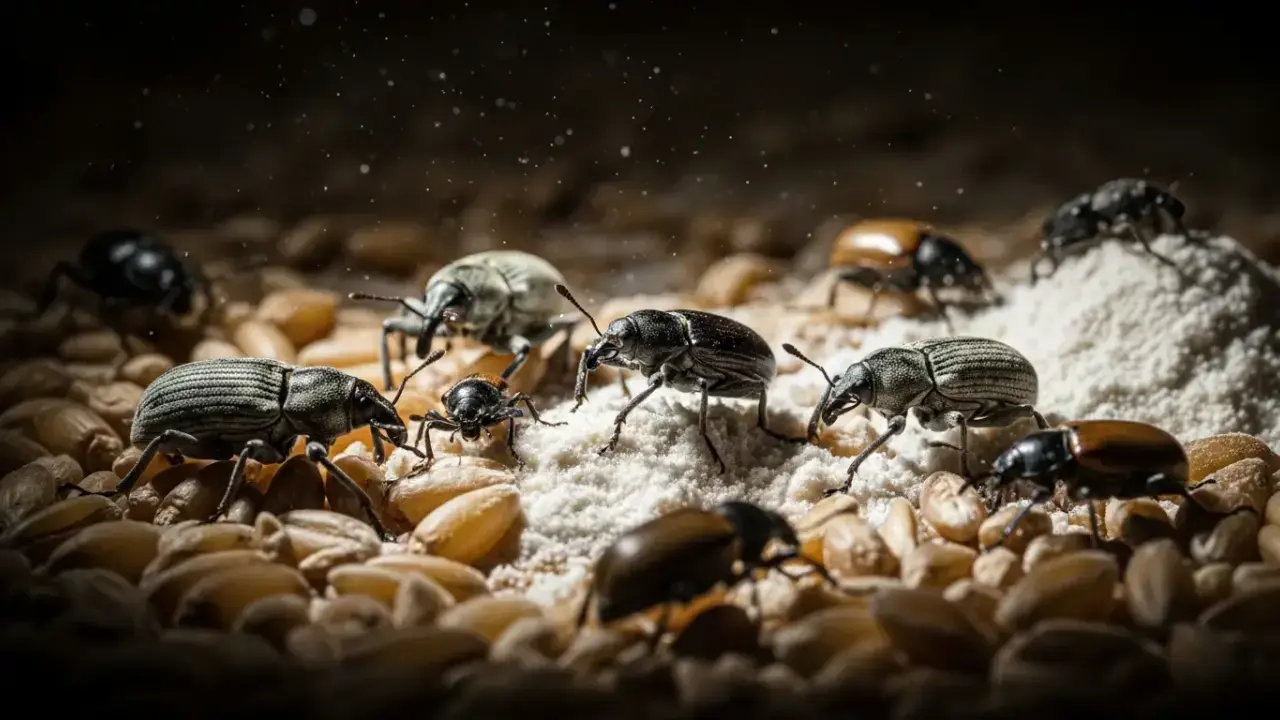
Stored Product Pests
Professional stored product insect control for businesses and homes across the North East. Species identification and targeted treatment for flour beetles, grain weevils, biscuit beetles, Indian meal moths, and mites. Heat treatment, fumigation, and pheromone monitoring.
Why You Need Professional Stored Product Pests
There are a variety of insects that can infest stored foods, damaging raw materials used in food production and feed, as well as contaminating finished products. This makes affected materials such as dried fruit, barley, rice, oil seeds, and wheat unfit for consumption. The majority of stored product pests are small beetles or moths. Stored product insects (SPIs) are a serious concern for any business that handles cereals, grains, or dried food products. They are also common in domestic settings, where they can be brought into the home hidden in contaminated foodstuffs or pet foods.
What's Included
Why acting quickly matters
Stored product insects can contaminate entire stock rooms. Many species are so small that an infestation may not be noticed at first. The longer an infestation is left, the more difficult it becomes to find all sources. Act quickly to minimise stock losses.
Insects in Your Food Stores?
Rapid response for homes and commercial premises across the North East. Species identification and targeted treatment to protect stock and compliance.
Request a free call back
Prefer to get in touch another way? Contact us or email info@wynyardpestcontrol.co.uk
Related Services
Threat Assessment
Nuisance:
6/10MODERATESPIs contaminate food products, damage raw materials, and render stock unfit for consumption. Infestations spread quickly through storage areas and may go unnoticed until significant damage has occurred.
Hazard:
7/10HIGHContamination of foodstuffs poses a health risk. Non-compliance with food safety legislation can lead to fines, prosecution, or closure. Larval webbing can damage processing machinery. Flour and cheese mites can cause skin and gut irritation.
Vital Statistics
| Common beetles | Flour Beetle, Grain Weevil, Biscuit Beetle, Saw-Toothed Grain Beetle |
| Common moths | Indian Meal Moth, Mill Moth, Warehouse Moth |
| Size range | 0.5 mm (mites) to 20 mm (Yellow Mealworm) |
| Foods at risk | Flour, cereals, grain, dried fruit, nuts, spices, pet food, bird seed |
| Indian meal moth diet | Nuts, dried fruit, grain, cereals, dried herbs, spices, dog food, bird seed |
| Flour mite lifespan | 9 to 11 days at 23 degrees and 90% humidity |
| Cheese mite eggs | Up to 900 per female (20 to 30 per day) |
| Grain weevil lifespan | 8 to 16 weeks in favourable conditions |
Key Facts
- SPIs can chew through packaging to access food inside, meaning sealed products are not immune from infestation
- Infected grain is liable to become warmer, accelerating insect problems and leading to damp, mould, and even grain germination
- Larval webbing produced by warehouse and mill moths can cause serious blockages and damage to processing machinery
- Non-compliance with food safety legislation can lead to commodities being rejected, fines, prosecution, or business closure
- Pheromone disruption systems offer an insecticide-free, non-toxic approach to controlling stored product moths in food industry environments
Stored Product Pest Problem?
Whether you have found insects in your kitchen cupboards or need commercial-grade protection for food storage facilities, contact us for expert identification and targeted treatment.
Signs of Infestation
- Damage to raw materials: Visible holes, tunnelling, and deterioration of stored products
- Exit holes in grain: Emerging adult weevils leave visible exit holes as they bore out of grains
- Warm grain: Infected grain is liable to become warmer, accelerating insect problems and leading to damp, mould, and even grain germination
- Insect tracks: Tracks through floury dust created as adults move from one food source to the next
- Larval webbing: Produced by warehouse and mill moth larvae as they feed and spread, which can cause serious blockages and damage to processing machinery
- Discolouration: Flour and grain beetles can cause discolouration of commodities and make them prone to moulding
- Tainting: Pests can taint goods with their waste materials, making them unfit for consumption
Food businesses, warehouses, and storage facilities across Darlington, Stockton, and Middlesbrough should arrange professional inspection at the first sign of contamination.
Common Beetle and Weevil Species
- Confused Flour Beetle (Tribolium confusum): 3 to 4 mm, red-brown. Feeds on and pupates in flour and cereal products. Adults may live up to 6 months
- Saw-Toothed Grain Beetle (Oryzaephilus surinamensis): 2.5 to 3 mm with 6 saw-like projections on each side of thorax. More tolerant to temperature extremes than other pest beetles. Feeds on cereals, dried fruit, and nuts
- Biscuit Beetle (Stegobium paniceum): 2 to 3 mm with humped thorax. Can bore into hard substances. Adults do not feed; larvae active in early stages
- Grain Weevil (Sitophilus granarius): 2 to 3 mm, black-brown. Adults live 8 to 16 weeks. Newly emerged adults leave identifiable emergence holes in grain
- Rice Weevil (Sitophilus oryzae): 2 to 3 mm with reddish spots on wing cases. Adults can live several months to a year. Larvae will not develop below 16 degrees
- Larder Beetle (Dermestidae): Black with a whitish band across the fore-part of wing case. Feeds on various animal products including cheese. Lifespan approximately 2 to 3 months
Common Moth and Mite Species
Moths
- Indian Meal Moth (Plodia interpunctella): 7 to 9 mm, first third of forewings pale buff, remainder reddish-brown. Feeds on nuts, dried fruit, grain, cereals, dried herbs, spices, dry dog food, and bird seed. Can chew through packaging
- Mill Moth (Ephestia kuehniella): 7 to 9 mm with black zig-zag pattern across grey wings. Prolific silk spinners. A pest particular to flour
- Warehouse Moth (Ephestia elutella): 7 to 9 mm, grey-brown banded. A formidable pest of cocoa beans, chocolate confectionary, dried fruit, and nuts
Mites
- Flour Mite (Acarus siro): Up to 0.5 mm, white or pale brown. Lifespan 9 to 11 days at optimum conditions. Under adverse conditions may enter a long, very resistant dormant stage
- Cheese Mite: Up to 0.5 mm with soft hairy cream-white bodies. Females can lay up to 900 eggs. Capable of contaminating foods to cause skin or gut irritation
Treatment Programme
Treatment depends on the species involved, the scale of the infestation, and the environment. Treatment always begins with identification, removal of infested materials, and thorough cleaning before any method is applied. Options include targeted insecticide, chemical-free heat treatment, and professional fumigation for large-scale infestations.
Prevention and Control
- Deep cleaning: Regular specialist hygiene deep cleaning of process and production areas and storage silos
- Proper storage: Store all food products including dry pet food in strong, tightly sealed containers. This is the single most effective long-term prevention measure
- Act quickly: The longer an infestation is left, the more difficult it becomes to find all sources
- Remove source materials: Eliminate infected foodstuffs and clean up any spillages
- Inspect deliveries: Check incoming stock for signs of infestation before placing in storage areas
- Stock rotation: Use first-in, first-out practices to prevent products sitting undisturbed for extended periods
- Professional identification: Identify the problem species with help from field biologists for the most effective treatment
Stored product pests are often found alongside textile moths and cockroaches in food handling environments. Businesses across Hartlepool, Durham, and Sunderland can arrange a free site survey. Industrial and hospitality premises should consider ongoing monitoring programmes. Learn more about how we work with commercial clients.
Before and After Treatment
Before Treatment
- Remove all food items from affected cupboards, drawers, and storage areas and inspect each one carefully for signs of infestation
- Dispose of any infested food in sealed bags in an outdoor bin. Do not put them in an indoor bin as adult insects can escape
- Empty and thoroughly vacuum all affected cupboards, drawers, and shelving including cracks, corners, and hinges
- Pull out kitchen appliances and vacuum underneath and behind them
- Remove pet food, bird seed, and dry animal feed from the treatment area
After Treatment
- Do not return food to treated cupboards for at least 24 hours after spray treatment
- Line shelves with fresh paper or shelf liner before returning food to cupboards
- Store all dry foods in airtight sealed containers going forward
- Continue checking for new activity over the following 2 to 4 weeks as residual larvae may emerge
- For fumigation: property must remain fully vacated for the duration specified by the technician
Is Treatment Safe for Children and Pets?
- Insecticide spray: Vacate treated areas for 2 to 4 hours until surfaces are dry. Do not place food directly onto treated surfaces until fully dry
- Heat treatment: Completely chemical-free. Safe to return immediately once the treatment unit is removed. Fish tanks, reptiles, and birds should be removed from the treated room during treatment as high temperatures can be harmful
- Fumigation: The entire property must be vacated by all people and pets for the full fumigation period (typically overnight to 24 hours). Re-entry only permitted after the technician has confirmed it is safe
- Pheromone disruption: Entirely non-toxic. No vacate period required. Safe for all household members and pets throughout
DIY vs Wynyard Pest Control
Store all dry goods in airtight containers after purchase. Larvae can chew through cardboard and thin plastic packaging.
| DIY | Wynyard Pest Control | |
|---|---|---|
| Best for | Single contaminated packet | Recurring or widespread infestation |
| Species identified | ✗ Often misidentified | ✓ Professional ID determines source |
| Source located | ✗ Visible items only | ✓ Full stock and storage survey |
| Pet and child safe | ✓ Disposal is safe | ✓ Targeted treatment in food-safe areas |
| Effectiveness | Removes visible contamination | Source eliminated and monitored |
| Follow-up visits | ✗ None | ✓ Monitoring programme included |
| Guarantee | ✗ None | ✓ Elimination guarantee |
When DIY may be sufficient: A single packet of flour or cereal containing weevils or moth larvae. Dispose of the contaminated product, clean the cupboard thoroughly, and store remaining dry goods in airtight containers.
When you need Wynyard Pest Control: If you are finding insects in multiple products, seeing small moths flying in the kitchen, or discovering beetles in stored goods repeatedly, the infestation has spread. Food businesses, retail premises, and warehouses across Hartlepool, Darlington, and Middlesbrough need professional monitoring with pheromone traps and targeted treatment to meet audit standards.
Seasonal Stored Product Pest Activity in the North East
Hover or tap a month to see Stored Product Pests activity details
Indoor infestations continue in heated premises. Mites and beetles active in warm storage areas.
Stored product pests remain active indoors. Check dried goods and pet food for signs of contamination.
Rising temperatures increase beetle and moth activity. Spring stock checks recommended.
Breeding activity increases. Indian Meal Moths and warehouse moths becoming more active.
Warmer conditions accelerate reproduction. Moth and beetle populations growing in stored goods.
Peak activity for many species. Adults appear in greater numbers. Grain weevils and flour beetles breeding rapidly.
Peak season continues. Warm conditions ideal for rapid population growth across all species.
High activity continues. Mite populations can build quickly in warm, humid storage areas.
Activity remains steady. Harvest season brings new grain and cereals into storage.
Second peak for some species. New season stock vulnerable to infestation from residual populations.
Activity reduces in unheated areas but continues in warm commercial premises.
Infestations persist in heated buildings. Festive food stocks create new food sources.
Stored product insects breed faster in warm, humid conditions. Summer is the peak risk period for warehouses, food manufacturers, and retailers, but heated storage facilities face year-round risk. Infestations often arrive with incoming goods, making inspection on delivery a critical control measure at any time of year.
Inspect all incoming stock on delivery, especially during warmer months. A single infested pallet can contaminate an entire storage area within weeks.
Spring (March to May) - Breeding accelerates: As ambient temperatures rise, stored product beetles, weevils, and moths become noticeably more active. Indian meal moths begin laying eggs in cereals, dried fruit, and flour. Grain weevils and biscuit beetles emerge from infested products that have sat undisturbed through winter. Watch for: small moths fluttering near kitchen cupboards and pantry areas, fine webbing over the surface of stored cereals and flour, and tiny holes in grain packaging in warehouses and food storage areas across Hartlepool, Sunderland, and Durham.
Summer (June to August) - Peak activity: Warm conditions drive the fastest breeding cycles. A single Indian meal moth can lay over 300 eggs, and larvae develop quickly in warm stored goods. Food businesses, hospitality kitchens, and warehouse environments see the highest risk during this period. Watch for: increasing numbers of small beetles on shelves and windowsills, larvae crawling away from food sources to pupate on walls and ceilings, mite infestations in flour and animal feed producing a sweet musty smell, and adult moths trapped in pheromone monitoring units.
Autumn (September to November) - Harvest season brings fresh risk: New grain, cereals, and dried goods entering storage after harvest can introduce pests directly from the field. Cross-contamination between infested and clean stock is common in shared storage facilities. Watch for: beetles appearing in newly delivered stock, webbing in bulk-stored products, and mites building up in warm, humid storage conditions across premises in Middlesbrough, Stockton, and Darlington. Autumn stock audits and pheromone trap monitoring are important preventative measures.
Winter (December to February) - Heated premises remain at risk: In unheated outbuildings and garages, pest development slows considerably. However, in centrally heated homes, commercial kitchens, and temperature-controlled warehouses, stored product pests continue breeding throughout winter. Watch for: adult beetles and moths appearing near windows and light fittings in kitchens, larvae in spice racks, dried pet food, and bird seed, and ongoing catches in pheromone monitoring traps. Winter is an ideal time to deep-clean storage areas, dispose of old or rarely used dry goods, and transfer remaining stock into airtight containers.
Our Stored Product Pests Process
A structured, three-stage approach that treats the problem and prevents it returning.
Step 1
Inspect and Plan
A detailed property inspection identifies entry points, infestation hotspots, and the species involved. A targeted treatment plan is developed based on findings.
Step 2
Treatment
Professional control measures are applied using advanced techniques and CRRU-compliant products. Proofing and sealing work addresses the root cause at the same time.
Step 3
Ongoing Support
Follow-up visits confirm the problem is resolved. You receive clear documentation, prevention advice, and recommendations for ongoing protection.
Why Choose Us for Stored Product Pests
Species Identification
We identify the exact pest species with help from field biologists to determine the source and the most effective treatment.
Audit-Ready Documentation
Full reports and monitoring records satisfy BRC, SALSA, and retailer audit standards.
Multiple Treatment Options
Targeted sprays, chemical-free heat treatment, fumigation, and pheromone disruption to suit any environment.
Monitoring Programmes
Ongoing trap monitoring catches new activity early before stock is affected.

NPTA Member
We are full members of the National Pest Technicians Association (NPTA). This means our technicians meet strict training and competency standards, carry appropriate insurance, and follow the association's code of practice. NPTA membership is your assurance that the work is carried out professionally and responsibly.
Fair, Transparent Pricing
Every job is different. The cost depends on the type of pest, scale of the problem, and what treatment is needed. We provide a free assessment and an honest quotation before any work begins. No hidden costs, no surprises.
View our pricing guideSatisfaction Guaranteed
All stored product pest treatments include follow-up monitoring. If activity persists after treatment, we will return and re-treat at no additional charge.
Frequently Asked Questions
Stored product insects (SPIs) are a variety of beetles, weevils, moths, and mites that infest stored foods. They damage raw materials used in food and feed production, and contaminate finished products making them unfit for consumption.
The most common species found in domestic settings are flour beetles (which breed in milled grain, flour, rice, oats, and cereals), the saw-toothed grain beetle (which eats cereals, dried fruits, macaroni, and crackers), and the Indian meal moth (which infests cereals, dried fruits, nuts, dried herbs, spices, dry dog food, fish food, cake mixes, and bird seed).
SPIs are commonly brought into homes hidden in contaminated foodstuffs or pet foods purchased from shops. Many species are so small that the infestation may not be noticed until it has spread.
Yes. Larval webbing produced by warehouse and mill moths as they feed and spread can cause serious blockages and damage to processing and production area machinery.
Act quickly. Remove the source materials of the infestation, clean up any spillages, and store all food products in strong, tightly sealed containers. For significant infestations, professional treatment is recommended.
Related Services
Our Other Services
Areas We Cover
We provide stored product pests services across the North East of England.
Ready to talk to us?
Free survey and quotation for businesses and homeowners. No obligation, no pressure.
We will get back to you as soon as we can.