
Deer Management
Professional deer management for rural estates, farms, and woodland across the North East. Licensed stalkers, legal compliance, and population management.
Why You Need Professional Deer Management
The UK has six species of wild deer, four of which are commonly found in the North East: roe deer, fallow deer, red deer, and muntjac. Without natural predators, deer populations must be managed to prevent damage to woodland, crops, gardens, and natural habitats. We provide professional deer management carried out by trained, licensed stalkers holding Deer Stalking Certificates (DSC), in full compliance with the Deer Act 1991.
What's Included
Why acting quickly matters
Deer damage to crops and woodland accumulates over time. Browsing prevents tree regeneration, and the longer an area is exposed to high deer pressure without management, the more significant the ecological and economic impact. Early assessment and a structured management plan prevent damage from reaching levels that are difficult and expensive to reverse.
Deer damaging your woodland, crops, or garden?
Free assessment and quotation. Licensed stalkers, legal compliance, and long-term management programmes.
Request a free call back
Prefer to get in touch another way? Contact us or email info@wynyardpestcontrol.co.uk
Related Services
Threat Assessment
Nuisance:
7/10HIGHDeer cause extensive damage to woodland (browsing and bark stripping), agricultural crops (cereals, root crops, grassland), gardens (ornamental planting, vegetables, hedges), and young tree plantations. They can make new woodland plantings unviable without protection.
Hazard:
6/10MODERATEDeer are responsible for an estimated 74,000 road traffic accidents per year in the UK, causing injuries and fatalities. Deer carry ticks that transmit Lyme disease to humans. Overgrazing by deer degrades woodland habitats, reducing biodiversity. Unmanaged deer populations can cause ecological damage that takes decades to recover.
Vital Statistics
| UK deer species | 6 wild species (2 native, 4 introduced) |
| Roe deer (Capreolus capreolus) | 60 to 75cm shoulder height, 20 to 25kg |
| Fallow deer (Dama dama) | 80 to 95cm shoulder height, 40 to 80kg |
| Red deer (Cervus elaphus) | 100 to 120cm shoulder height, 90 to 190kg |
| Muntjac (Muntiacus reevesi) | 45 to 52cm shoulder height, 10 to 18kg |
| Estimated UK deer population | Approximately 2.5 million |
| Road traffic accidents | Estimated 74,000 per year in the UK |
| Roe deer breeding | Rut in July to August, kids born May to June |
| Primary legislation | Deer Act 1991 (England and Wales) |
| Minimum calibre (England) | .243 Winchester or equivalent for all deer species |
Key Facts
- Deer cause an estimated 74,000 road traffic accidents per year in the UK, resulting in around 450 human injuries and approximately 20 fatalities annually.
- Deer carry ticks that transmit Lyme disease to humans. Lyme disease can cause long-term neurological, joint, and cardiac problems if not diagnosed and treated early.
- Overgrazing by deer prevents woodland regeneration. Young trees, shrubs, and ground flora are browsed before they can establish, leading to open, degraded woodland with reduced biodiversity.
- The Deer Act 1991 regulates deer culling with specific open seasons for each species and sex. Culling outside the open season or using prohibited methods is a criminal offence.
- Roe deer are the most common deer species in the North East and are native to Britain. They are solitary or found in small family groups.
- Muntjac deer, introduced from China, have no fixed breeding season and can breed year-round. They are small but cause significant damage to garden plants and woodland understorey.
- Deer fencing for woodland protection is typically 1.8m for roe and muntjac and 2.0m for fallow and red deer. It is a significant investment but protects new plantings effectively.
- The UK has no natural deer predators (wolves were hunted to extinction in the 18th century), making human management essential to maintain deer populations at sustainable levels.
- Professional deer management contributes to habitat conservation, road safety, crop protection, and maintains healthy deer populations with balanced age and sex ratios.
"Amazing job"
Eleonore Colley · Google review, April 2026
Need a deer management plan?
We assess the species, population pressure, and damage, and develop a management programme that delivers results.
Deer Species in the North East
Four species of deer are commonly found in the North East of England. Identifying which species is present is the first step in developing an effective management plan, as each species has different behaviour, habitat preferences, and legal open seasons.
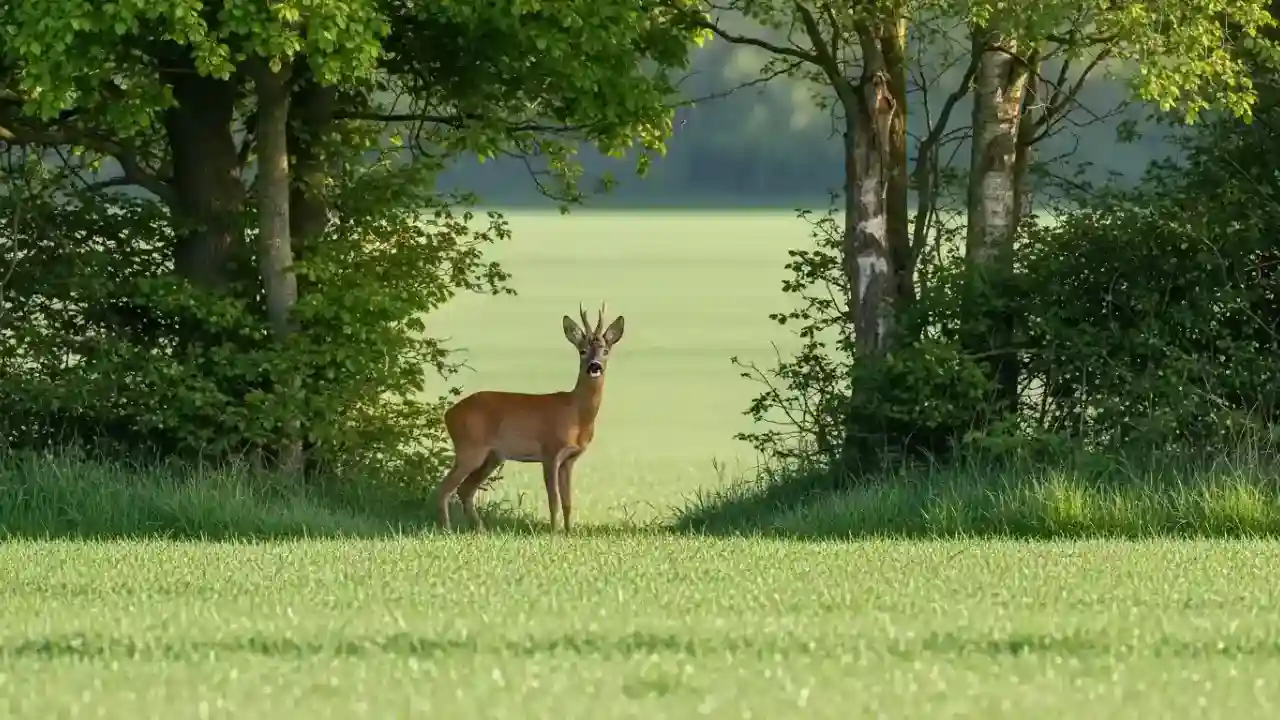
Roe deer (Capreolus capreolus): The most common deer in the North East and one of only two native deer species in Britain. A small, elegant deer standing 60 to 75cm at the shoulder and weighing 20 to 25kg. Summer coat is reddish-brown, turning grey-brown in winter. White rump patch is prominent, particularly when alarmed. Bucks carry short, upright antlers with typically three points. Roe deer are solitary or found in small family groups. They prefer woodland edges, hedgerows, and areas with mixed cover and open ground.
Fallow deer (Dama dama): Introduced by the Normans in the 11th century. A medium-sized deer standing 80 to 95cm at the shoulder. The most variable in colour of any deer species, ranging from common (tan with white spots in summer), menil (pale, heavily spotted), to melanistic (very dark brown or black). Bucks carry broad, palmate (flattened) antlers. Fallow deer are gregarious and form herds. Found in parkland, mature woodland, and agricultural land.
Red deer (Cervus elaphus): The UK's largest native land mammal. Stags stand 100 to 120cm at the shoulder and can weigh up to 190kg. Rich brown coat. Stags carry large, branching antlers. Found on upland moorland, forestry plantations, and large estates in the North East. Red deer form separate male and female herds for most of the year, coming together during the rut in September to October.
Muntjac (Muntiacus reevesi): The smallest deer in the UK, standing just 45 to 52cm at the shoulder and weighing 10 to 18kg. Originally from China, released and escaped from Woburn Park in the early 20th century. Russet-brown coat, hunched posture, and short antlers on bucks. Muntjac have no fixed breeding season and can breed year-round. They are solitary, territorial, and cause significant damage to garden plants and woodland understorey. Increasingly present in the North East.
Signs of Deer Damage
Deer damage is cumulative. Browsing that appears minor in a single season can prevent woodland regeneration over years and decades if populations are not managed.
Recognising the signs of deer damage helps you assess the severity of the problem and the species responsible.
- Browse damage: Shoots, buds, and leaves bitten off at a characteristic height. Roe and muntjac browse up to about 1 metre; fallow and red deer browse up to 1.5 to 2 metres. The browsing line (a clear horizontal line above which foliage remains) is a distinctive indicator of deer pressure.
- Bark stripping: Deer strip bark from young trees, particularly in winter and spring. This can ring-bark and kill trees. Red and fallow deer are the most common culprits. Bark damage shows irregular, vertical strips with visible tooth marks.
- Fraying: Bucks rub their antlers against young trees to remove velvet and mark territory, stripping bark and breaking stems. Fraying damage is concentrated on saplings with stem diameters of 2 to 8cm and typically occurs in late summer and autumn.
- Tracks: Cloven hoof prints in soft ground, mud, and snow. Deer tracks are narrower and more pointed than sheep or cattle prints. Track size indicates the species: roe (4 to 5cm), muntjac (3 to 4cm), fallow (6 to 7cm), red (7 to 9cm).
- Droppings: Small, dark, cylindrical pellets. Roe and muntjac droppings are 10 to 14mm long. Fallow droppings are slightly larger. Red deer droppings are 20 to 25mm and may be clumped together.
- Crop damage: Trampling and grazing of cereals, root crops, and grassland. Damage is often concentrated along field edges adjacent to woodland and hedgerows.
The Deer Act 1991
The Deer Act 1991 sets strict legal requirements for deer culling including open seasons, permitted firearms, and prohibited methods. Non-compliance is a criminal offence.
The Deer Act 1991 is the primary legislation governing deer management in England and Wales. All deer stalking must comply with its provisions.
Open seasons (England and Wales):
- Roe deer: Bucks 1 April to 31 October. Does 1 November to 31 March.
- Fallow deer: Bucks 1 August to 30 April. Does 1 November to 31 March.
- Red deer: Stags 1 August to 30 April. Hinds 1 November to 31 March.
- Muntjac: No close season (can be managed year-round due to no fixed breeding season).
Permitted firearms: A rifle of at least .243 Winchester calibre (or equivalent) firing a bullet of at least 100 grains with a muzzle energy of at least 1,700 foot-pounds is the legal minimum for all deer species in England. Shotguns with specific ammunition may be used in certain circumstances.
Prohibited methods: It is illegal to use traps, snares, nets, or poison to take or kill deer. Shooting deer from a moving vehicle is prohibited. Using artificial light to locate deer for the purpose of shooting is prohibited except under specific licence.
Night shooting: Night shooting of deer is prohibited except under a specific licence from Natural England, which is only granted to prevent serious damage to crops, timber, or other property.
Out-of-season culling: Culling outside the legal open season requires a specific licence from Natural England and is only justified where deer are causing serious damage that cannot be prevented by other means.
Deer Management Planning
Effective deer management requires a structured, long-term approach. One-off culling operations rarely achieve lasting results without a wider management plan.
A deer management plan provides a structured framework for achieving population and damage reduction targets over time. We develop management plans for estates, farms, and woodland owners based on a thorough assessment of the local situation.
Population assessment: We carry out deer counts using standardised methods (vehicle counts at dawn and dusk, walked transects, trail cameras) to estimate the species present, approximate population size, and sex and age structure. This baseline assessment informs the cull plan.
Cull plan: Based on the population assessment and the level of damage, we develop an annual cull plan specifying the number of deer to be taken, the species and sex, and the timing of operations within the legal open seasons. The cull plan aims to achieve a sustainable population level that minimises damage while maintaining a healthy, balanced deer population.
Stalking programme: Culling is carried out by our DSC-qualified stalkers using legal rifles and ammunition. All stalking operations include a detailed risk assessment covering shooting positions, backstops, and proximity to roads, buildings, and public rights of way. We use high seats and shooting positions selected for safety and effectiveness.
Monitoring and review: We monitor the outcome of management through regular population counts, damage assessments, and analysis of cull data (weight, condition, reproductive status). The management plan is reviewed and adjusted annually based on these findings.
Woodland and Crop Protection
Deer browsing is the single biggest threat to new woodland establishment in England. Without protection, young trees in most lowland areas will be browsed before they can grow above the deer browse line.
Woodland protection:
- Deer fencing: The most reliable protection for new woodland plantings. Minimum height: 1.8m for roe and muntjac, 2.0m for fallow and red deer. Specification: high-tensile steel wire with a maximum mesh size of 150mm x 150mm, installed with straining posts and stays at corners and changes of direction. Properly installed deer fencing can last 20 to 30 years.
- Tree guards: Individual tree protection using mesh or solid tube guards. Effective for small plantings, amenity trees, and hedgerow trees. Height: 1.2m for roe and muntjac, 1.8m for fallow and red deer.
- Population management: Where fencing is impractical (large areas, public access, aesthetic concerns), deer population reduction through stalking is the primary management tool.
Crop protection: Deer fencing around high-value crops (vegetable production, fruit orchards, nursery stock) provides the most reliable protection. For arable crops, population management across the wider landscape is usually more practical than fencing individual fields. Targeted stalking focused on the deer causing crop damage can reduce losses significantly.
Seasonal Deer Activity in the North East
Hover or tap a month to see Deer Management activity details
Female deer open season (roe does, fallow does, red hinds). Winter browsing and bark stripping damage.
Female season continues. Deer concentrated in sheltered areas. Bark stripping damage peaks.
Last month of female season (roe does, fallow does, red hinds). Planning for spring assessments.
Roe buck season opens. Fallow buck and red stag seasons open. Spring growth attracts deer to crops.
Roe kids born. Browsing damage to new growth. Active management period for buck species.
Peak browsing on young crops and woodland. Buck management continues. Population assessment period.
Roe deer rut begins. Bucks territorial and active. Fraying damage to young trees. Crop damage continues.
Roe rut peaks. Fallow and red buck seasons continue. Harvest period with deer moving between crop and cover.
Red deer rut begins. Fallow deer rut approaching. Deer-vehicle collision risk increasing with shorter days.
Red and fallow deer rut peaks. Maximum deer-vehicle collision risk. Clock change increases dawn/dusk traffic risk.
Female open season begins. Peak road collision risk continues. Deer moving to winter cover.
Female season continues. Winter browsing and bark stripping. Deer concentrated in woodland and sheltered areas.
Deer management follows a strict legal calendar of open seasons. The roe buck season runs from April to October, while fallow and red deer stag seasons run from August to April. Female seasons for all species with a close season run from November to March. The autumn rut (September to November) is the highest-risk period for deer-vehicle collisions. Browsing and bark stripping damage is worst during winter when other food sources are scarce.
Planning a deer management programme? Contact us in autumn to develop a management plan ahead of the winter stalking season. Early assessment allows time to obtain any necessary permissions and prepare for effective management.
Spring (April to June) - Calving and browse damage: Does and hinds give birth between May and July, making them more sensitive to disturbance. Browse damage to young trees, crops, and garden plants peaks as deer seek nutrient-rich new growth. Roe buck stalking season opens in April. This is a critical period for monitoring deer numbers and planning management programmes for farms and estates.
Summer (July to September) - Peak activity: Roe deer rut occurs in July and August, with bucks becoming more active and visible. Red and fallow stag seasons open in August. Agricultural crop damage from deer grazing and trampling is at its highest. Summer is also the peak period for deer-vehicle collisions as animals move between feeding and breeding areas.
Autumn (October to December) - Red and fallow rut: The red deer rut peaks in October, with fallow deer rutting through October and November. Bark stripping damage to trees increases as bucks mark territory. Fallow and red deer stag seasons continue. This is often the most effective period for population management on estates and large landholdings.
Winter (January to March) - Hind and doe seasons: Female deer open seasons run through winter (red hinds November to March, fallow does November to March, roe does November to March). Winter management is essential for maintaining sustainable population levels. Deer move to sheltered woodland and feeding areas, making census and management planning most practical.
Why Choose Us for Deer Management
Licensed Stalkers
All deer management is carried out by trained, licensed stalkers with current Deer Stalking Certificate (DSC) qualifications and valid firearms certificates.
Legal Compliance
We operate in full compliance with the Deer Act 1991, including open season restrictions, permitted firearms, and prohibited methods. Non-compliance is a criminal offence.
Estate Management
We work with rural estates, farms, forestry operations, and woodland owners to develop long-term deer management plans that balance population control with conservation.
Safety First
Rigorous risk assessment for every stalking operation. All operations are covered by comprehensive public liability insurance.
Population Monitoring
We carry out regular population assessments using standardised methods and adjust management plans based on monitoring data and damage trends.
Coordinated Management
Effective deer management often requires coordination across neighbouring landholdings. We help landowners and estates work together for better results.
Deer and Road Safety
Deer are responsible for an estimated 74,000 road traffic accidents per year in the UK, causing approximately 20 fatalities and 450 serious injuries annually.
Deer-vehicle collisions are a serious safety concern on rural roads in the North East, particularly during the autumn rut (October to November for fallow and red deer) and spring dispersal (May to June for roe deer).
High-risk periods: Dawn and dusk are the highest-risk times, coinciding with deer activity patterns and commuter traffic. The autumn clocks change in late October places rush hour traffic into the peak deer activity window. Spring evenings are also high-risk when roe deer are dispersing to new territories.
High-risk locations: Roads passing through or adjacent to woodland, plantation edges, and hedgerow corridors are most affected. Deer tend to follow established crossing points, and deer warning signs should be taken seriously in these areas.
What to do if you hit a deer: Stop in a safe place and turn on hazard lights. Report the collision to the police, particularly if the deer is injured but not dead. Do not approach an injured deer as it may kick or lash out. If the deer is in the road causing a hazard, report this to the police immediately. Your insurance company should be notified.
Deer management in the areas surrounding high-risk roads can reduce collision rates by lowering the local deer population and reducing the frequency of road crossings. We work with landowners, estates, and local authorities to implement deer management programmes that address road safety alongside other damage objectives.
Deer Fencing Specification
Deer fencing is a significant investment, but properly specified and installed fencing provides the most reliable long-term protection for woodland, crops, and gardens.
Standard woodland deer fence:
- Height: 1.8m (roe and muntjac) or 2.0m (fallow and red deer)
- Material: High-tensile galvanised steel wire mesh
- Mesh size: Maximum 150mm x 150mm for stock fencing with a 100mm x 100mm bottom section to exclude muntjac
- Posts: Treated timber at 4 to 6 metre intervals, with straining assemblies at all corners, ends, and changes of direction
- Gates: All gates to the same height specification with self-closing mechanisms
Garden deer fencing: For domestic gardens where aesthetics are important, options include black polyethylene mesh (less visible than steel), post and rail with mesh infill, and even decorative metal estate fencing at appropriate height. Electric fencing systems specifically designed for deer deterrence are also available.
Cost considerations: Deer fencing costs vary with specification, terrain, and length. Woodland-grade fencing typically costs between 10 and 20 pounds per metre depending on the specification. For large plantings, fencing is almost always more cost-effective than individual tree guards. The fence should be seen as a long-term investment that protects decades of tree growth.
Deer Stalking Qualifications
Professional deer management must be carried out by trained, competent stalkers. All Wynyard Pest Control stalkers hold the Deer Stalking Certificate (DSC) and operate to the highest professional standards.
Deer Stalking Certificate (DSC):
- DSC Level 1: Covers deer biology, identification, ecology, legislation, firearms safety, and marksmanship. The standard entry qualification for anyone involved in deer management.
- DSC Level 2: A more advanced qualification covering practical deer stalking, carcass management, butchery, and estate management. Demonstrates a high level of competence and professionalism.
Firearms certificate: All deer stalkers must hold a valid firearms certificate issued by the police, specifying the calibre and conditions under which the rifle may be used. The certificate must cover the calibre required by law for the deer species being managed.
Insurance: All our stalking operations are covered by comprehensive public liability insurance. We carry out detailed risk assessments for every stalking operation, covering shooting positions, backstops, proximity to roads and buildings, and any other relevant safety factors.
Best Practice: We follow the Best Practice Guidelines published by the Deer Initiative (now the Deer Management Qualification), covering humane culling standards, carcass handling, health and safety, and environmental awareness.
Deer and Lyme Disease
Deer carry ticks that transmit Lyme disease to humans. Lyme disease can cause long-term neurological, joint, and cardiac problems if not diagnosed and treated early.
Deer are the primary host for adult ticks (Ixodes ricinus) in the UK. Ticks feed on deer blood and use deer as a vehicle for reproduction and dispersal. Where deer populations are high, tick numbers are correspondingly elevated, increasing the risk of Lyme disease transmission to humans.
Lyme disease: Caused by the bacterium Borrelia burgdorferi, transmitted through tick bites. Not all ticks carry the bacterium, but infection rates in UK ticks can be 5 to 15% in some areas. Symptoms include a distinctive expanding red rash (erythema migrans) around the bite site, followed by flu-like symptoms. If untreated, Lyme disease can cause long-term neurological, joint, and cardiac problems.
Reducing tick exposure:
- Wear long trousers tucked into socks and light-coloured clothing when walking in areas with deer (ticks are easier to spot on light clothing).
- Use insect repellent containing DEET on exposed skin and clothing.
- Check your body for ticks after spending time in deer habitat. Pay particular attention to warm, hidden areas such as the groin, armpits, and hairline.
- Remove attached ticks promptly using a tick removal tool or fine-pointed tweezers. Grasp the tick as close to the skin as possible and pull steadily upward without twisting.
- If you develop a rash or flu-like symptoms after a tick bite, seek medical advice promptly. Early treatment with antibiotics is highly effective.
Deer management plays a role in reducing tick populations and Lyme disease risk. Studies have shown that reducing deer density in an area can significantly lower tick numbers. This is an increasingly important consideration for public land managers, schools, care homes, and outdoor recreation providers.
Our Deer Management Process
A structured, three-stage approach that treats the problem and prevents it returning.
Step 1
Inspect and Plan
A detailed property inspection identifies entry points, infestation hotspots, and the species involved. A targeted treatment plan is developed based on findings.
Step 2
Treatment
Professional control measures are applied using advanced techniques and CRRU-compliant products. Proofing and sealing work addresses the root cause at the same time.
Step 3
Ongoing Support
Follow-up visits confirm the problem is resolved. You receive clear documentation, prevention advice, and recommendations for ongoing protection.
Need a deer management plan?
We assess the species, population pressure, and damage, and develop a management programme that delivers results.
What to Expect from a Deer Management Assessment
Our deer management service begins with a thorough assessment of the situation on your land.
- Site visit: We walk the land to assess deer activity, identify species present, locate feeding areas, resting areas, and crossing points. We photograph signs of damage (browsing, bark stripping, fraying, crop damage, tracks, droppings) and note the severity and distribution.
- Population estimate: Using standardised survey methods, we estimate the approximate number of deer and the species and sex composition. This may involve dawn and dusk counts, trail camera deployment, and walked transect surveys.
- Damage assessment: We quantify the type and extent of damage to woodland, crops, gardens, or other assets. This helps establish the management objectives and the level of culling needed to achieve them.
- Management plan: We provide a written management plan covering the recommended annual cull (numbers by species and sex), the timing of operations within legal open seasons, the stalking methods and safety measures to be used, and the monitoring and review process.
- Implementation: Once the management plan is agreed, we implement the stalking programme, carrying out operations at the agreed times and providing regular reports on progress. The plan is reviewed and adjusted annually based on monitoring data.
"Top service, fast and responsive"
Christopher Nottingham · Google review, April 2026
NPTA Member
We are full members of the National Pest Technicians Association (NPTA). This means our technicians meet strict training and competency standards, carry appropriate insurance, and follow the association's code of practice. NPTA membership is your assurance that the work is carried out professionally and responsibly.
Fair, Transparent Pricing
Every job is different. The cost depends on the type of pest, scale of the problem, and what treatment is needed. We provide a free assessment and an honest quotation before any work begins. No hidden costs, no surprises.
View our pricing guideSatisfaction Guaranteed
Our deer management programmes are designed to achieve specific population and damage reduction targets agreed with the landowner. We monitor outcomes through regular assessment and adjust the management plan as needed. For contract clients, our programmes include scheduled stalking visits, population counts, and detailed reporting.
Frequently Asked Questions
Deer culling is regulated by the Deer Act 1991, with specific open seasons for each species and sex. Roe deer bucks: 1 April to 31 October. Roe does: 1 November to 31 March. Fallow bucks: 1 August to 30 April. Fallow does: 1 November to 31 March. Red stags: 1 August to 30 April. Red hinds: 1 November to 31 March. Muntjac have no close season. Out-of-season culling requires a specific licence from Natural England.
We can advise on deer management for properties of any size, but the most effective management is usually coordinated across larger areas in partnership with neighbouring landowners. For small gardens, deer fencing is often the most practical solution. We can advise on fencing specification for your situation.
In areas without natural predators (the UK has no wolves), deer populations grow to levels that cause significant damage to woodland, crops, gardens, and natural habitats. Unmanaged deer populations lead to overgrazing that prevents woodland regeneration, causes crop losses, increases road traffic accidents, and degrades biodiversity. Responsible management maintains populations at sustainable levels.
All our stalkers hold the Deer Stalking Certificate (DSC) Level 1 or Level 2, valid firearms certificates covering the appropriate calibres, and comprehensive public liability insurance. They follow the Best Practice Guidelines for deer management and carry out detailed risk assessments for every stalking operation.
Yes. Deer management in the areas surrounding high-risk roads can reduce collision rates by lowering the local deer population. We work with landowners, estates, and local authorities to implement management programmes that address road safety alongside other damage objectives.
Deer fencing costs depend on the specification, terrain, and length. Woodland-grade deer fencing typically costs between 10 and 20 pounds per metre installed. For large new woodland plantings, fencing is almost always more cost-effective than individual tree guards. We can advise on the most appropriate specification for your situation and provide a quotation.
Deer carcasses from our management operations are handled in accordance with food hygiene regulations. Where appropriate, venison can be made available to the landowner or processed for sale. All carcass handling follows the guidelines set out in the DSC programme and relevant food safety legislation.
We provide written assessments of deer damage to crops, woodland, and other assets. These assessments can support insurance claims, Countryside Stewardship applications, and other grant funding where evidence of deer impact is required.
Related Services
Our Other Services
Areas We Cover
We provide deer management services across the North East of England.
Ready to talk to us?
Free survey and quotation for businesses and homeowners. No obligation, no pressure.
We will get back to you as soon as we can.