
Woodworm Treatment
Professional woodworm identification, treatment, and timber surveys for commercial and residential properties across the North East. Common Furniture Beetle, Deathwatch Beetle, and House Longhorn Beetle.
Why You Need Professional Woodworm Treatment
Woodworm is the common name for the larvae of several wood-boring beetle species that tunnel through structural and decorative timbers, weakening them from the inside over a period of years. The damage is often hidden until adult beetles emerge, leaving the characteristic small round exit holes that most people recognise as woodworm. By the time exit holes appear, the larvae may have been feeding inside the timber for 2 to 5 years. Our NPTA-qualified technicians carry out thorough timber surveys to identify the species, determine whether the infestation is active or historic, and apply the appropriate treatment to eliminate the problem and protect your timbers long-term.
What's Included
Why acting quickly matters
Wood-boring beetle larvae feed inside timbers for 2 to 5 years before emerging as adults. During this time, they create extensive tunnel networks (galleries) that progressively weaken the timber from the inside. In structural timbers such as floor joists, roof rafters, and lintels, untreated woodworm can compromise structural integrity. Active infestations spread to adjacent timbers and can affect entire floors or roof structures if left untreated.
Concerned about woodworm?
Professional timber surveys and treatment across the North East. Written reports for property purchases and mortgage lenders.
Request a free call back
Prefer to get in touch another way? Contact us or email info@wynyardpestcontrol.co.uk
Threat Assessment
Nuisance:
5/10MODERATEWoodworm damage is primarily structural rather than immediately visible. Exit holes and frass (bore dust) are cosmetically unattractive in exposed timbers and furniture. The concern for most property owners is the implication of structural weakening rather than the visible signs themselves.
Hazard:
7/10HIGHSevere woodworm damage to structural timbers can compromise the load-bearing capacity of floor joists, roof rafters, purlins, and wall plates. Deathwatch Beetle and House Longhorn Beetle cause more severe damage than Common Furniture Beetle and can render structural timbers unsafe. Property surveyors routinely flag woodworm as a material defect affecting property value and mortgage lending.
Vital Statistics
| Most common species | Common Furniture Beetle (Anobium punctatum) |
| Exit hole size | 1 to 2mm (CFB), 3mm (Deathwatch), 6 to 10mm (House Longhorn) |
| Larval period | 2 to 5 years inside timber |
| Adult emergence | April to September (peak May to June) |
| Preferred conditions | Damp timber above 12% moisture content |
| Treatment methods | Spray, paste, gel, heat treatment, fumigation |
Key Facts
- Woodworm larvae feed inside timber for 2 to 5 years, creating extensive tunnel networks that weaken the wood from the inside. Damage is hidden until adult beetles emerge through exit holes.
- Deathwatch Beetle larvae cause more severe structural damage than Common Furniture Beetle and can render oak beams and structural timbers unsafe over time.
- House Longhorn Beetle is the most destructive UK wood-boring species. It attacks softwood roof timbers and can cause catastrophic structural failure. It is notifiable to the local authority in some areas.
- Damp timber is far more susceptible to woodworm attack. Timber with a moisture content above 12 percent is at significantly higher risk than dry timber.
- Not every exit hole means an active infestation. Many properties have historic woodworm damage where the beetles emerged years ago and the infestation has naturally ended. Professional assessment distinguishes active from historic damage.
- Common Furniture Beetle (Anobium punctatum) accounts for approximately 75 percent of all woodworm cases in the UK.
- Adult beetles emerge from timber between April and September, with peak emergence in May and June. Fresh exit holes with clean edges and fine bore dust (frass) below them indicate active infestation.
- Woodworm treatment for property purchase is one of the most common reasons homebuyers commission timber surveys. Mortgage lenders may require a specialist report before approving lending.
- Modern woodworm treatments use micro-emulsion or water-based insecticides that are significantly less odorous and less disruptive than the solvent-based treatments used historically.
"Top quality sevice, highly recomended"
Steven Benton · Google review, March 2026
Need a woodworm survey?
Free consultation and quotation for timber surveys and treatment across the North East. Active vs historic assessment before any treatment is recommended.
Woodworm Species in the UK
Common Furniture Beetle accounts for approximately 75 percent of all woodworm cases in the UK, but Deathwatch Beetle and House Longhorn Beetle cause more severe structural damage.
Several species of wood-boring beetle are found in the UK, and correct identification is essential because the species determines the severity of the threat, the timbers at risk, and the most effective treatment approach.
Common Furniture Beetle (Anobium punctatum): The most widespread species, responsible for approximately 75 percent of all woodworm cases in the UK. Adults are 3 to 5mm long, dark brown, with rows of pits on the wing cases. Exit holes are 1 to 2mm in diameter. Larvae attack both softwood and hardwood, preferring sapwood. Found in furniture, floorboards, joists, and roof timbers. Larval period is typically 3 to 5 years.
Deathwatch Beetle (Xestobium rufovillosum): Attacks hardwoods, particularly old oak timbers. More common in southern England but found in historic buildings throughout the UK. Adults are 6 to 9mm long, greyish-brown with patches of short hair. Exit holes are approximately 3mm in diameter. Larvae prefer timber that has been softened by fungal decay. Found in structural oak beams in churches, heritage buildings, and period properties. Larval period can exceed 10 years.
House Longhorn Beetle (Hylotrupes bajulus): The most destructive UK species. Attacks softwood roof timbers and can cause catastrophic structural failure. Adults are 10 to 20mm long, dark brown to black. Exit holes are 6 to 10mm, oval-shaped. Primarily found in parts of Surrey and Hampshire but occasionally identified elsewhere. Notifiable to the local authority in some areas due to the severity of damage.
Powder Post Beetle (Lyctus brunneus): Attacks the sapwood of hardwoods with large pores (oak, ash, elm). Exit holes are 1 to 2mm. Reduces timber to a fine powder. Common in recently imported hardwoods and new oak flooring.
Signs of Woodworm
Identifying woodworm involves looking for visible signs on and around timber surfaces:
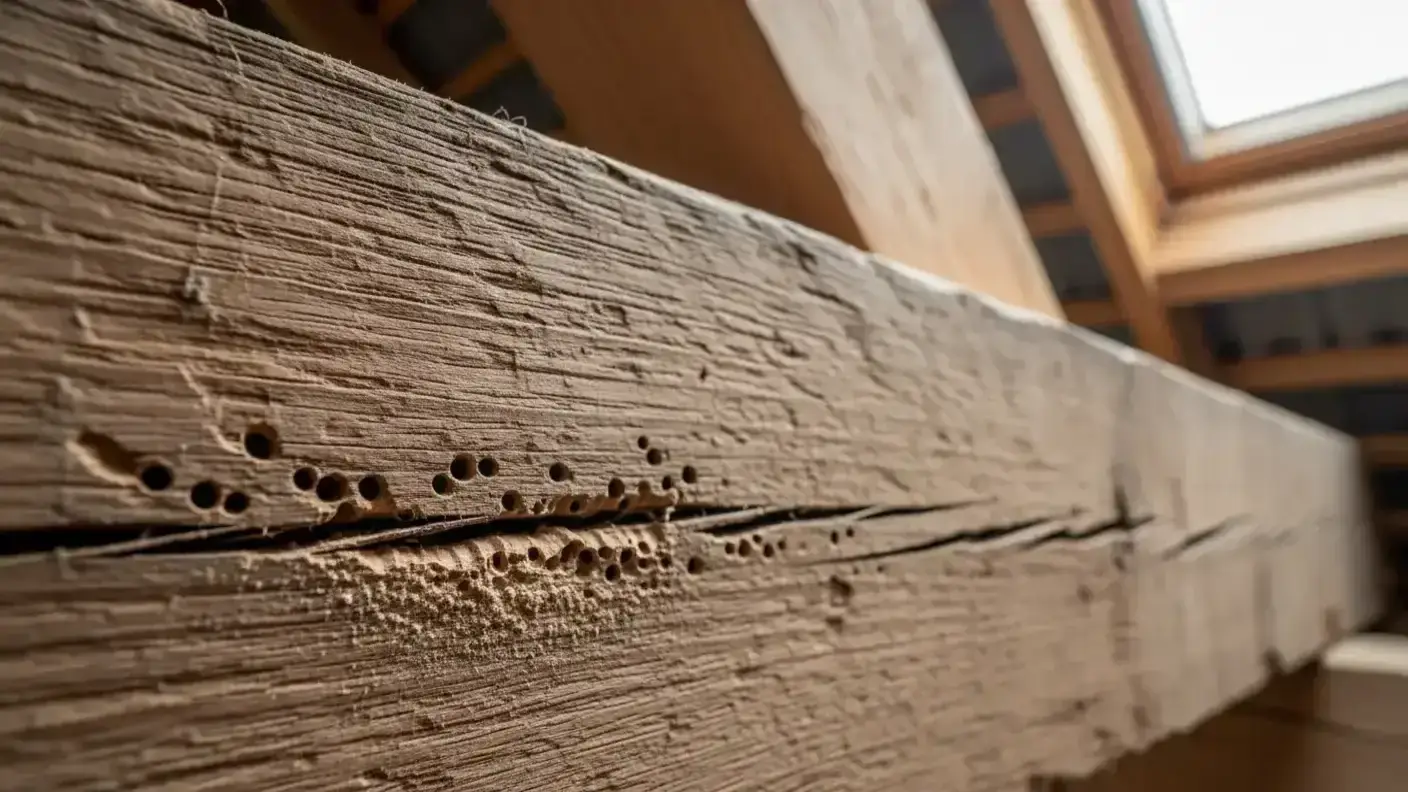
- Exit holes: Small round holes in the timber surface, typically 1 to 2mm for Common Furniture Beetle. Fresh holes have clean, sharp edges and light-coloured wood visible inside. Old holes are darker and may have accumulated dust or polish.
- Bore dust (frass): Fine powdery dust found beneath or around exit holes. Fresh frass is light in colour and has a gritty or flour-like texture. Its presence beneath exit holes is the strongest indicator of active infestation.
- Tunnels (galleries): If timber is broken or cut, internal tunnels created by larvae may be visible. The pattern and size of tunnels help identify the species.
- Weak or crumbling timber: In severe cases, timber becomes structurally weakened and may crumble when pressed or probed. This indicates extensive internal damage.
- Adult beetles: Small beetles found near windows or on timber surfaces between April and September. Dead beetles on windowsills are common during the emergence season.
If you are unsure whether damage is active or historic, contact us for a professional assessment. Treating historic (inactive) damage is unnecessary and avoidable expense.
Active vs Historic Woodworm
One of the most important assessments in any woodworm survey is determining whether the infestation is currently active or whether it ended naturally in the past.
Active infestation indicators: Fresh exit holes with clean, sharp edges and light-coloured wood inside. Fresh bore dust (frass) beneath exit holes, often in small piles. Frass is gritty to the touch and light in colour. Live or recently dead adult beetles on timber surfaces or windowsills during the emergence season (April to September).
Historic (inactive) indicators: Exit holes with rounded, darkened edges. No fresh bore dust. Holes filled with dust, paint, or polish. No adult beetles found during the emergence season.
Many properties, particularly older homes built before the widespread use of pre-treated timber, have historic woodworm damage that does not require treatment. The beetles emerged, the infestation naturally ran its course, and no new generation has re-infested the timber. A professional survey during the emergence season (April to September) is the most reliable way to confirm whether treatment is needed.
Treatment Methods
The treatment method depends on the species, the extent of the infestation, the type and accessibility of the affected timbers, and whether the property is occupied.
Surface spray treatment: The most common method for Common Furniture Beetle in accessible timbers. A micro-emulsion or water-based insecticide is sprayed onto the timber surface using low-pressure equipment. The insecticide penetrates into the outer layers of the timber, killing emerging adult beetles as they exit through the treated surface and preventing egg-laying on treated timbers. Modern formulations are low-odour and dry quickly.
Paste and gel treatments: Used for timbers where spray application is difficult or where deeper penetration is needed. Paste is applied to the timber surface and penetrates over time. Gel formulations can be injected into exit holes and cracks for targeted treatment of localised infestations.
Heat treatment: Professional heat treatment raises the temperature throughout the timber cross-section to levels lethal to larvae. This is the only method that reaches larvae deep inside large-section timbers without relying on their emergence through treated surfaces. Particularly suitable for heritage buildings and listed properties where chemical treatment may not be permitted.
Fumigation: Fumigation is used for severe infestations where timbers are inaccessible or where the extent of damage makes surface treatment impractical. The gas penetrates throughout the timber, killing all life stages.
The Relationship Between Damp and Woodworm
Timber with a moisture content above 12 percent is significantly more susceptible to woodworm attack. Addressing damp is as important as treating the beetles.
Damp timber is the single most important risk factor for woodworm infestation. Wood-boring beetles preferentially lay their eggs on timber with a moisture content above approximately 12 percent. Dry, well-ventilated timber is far less attractive to egg-laying females and far less supportive of larval development.
Common causes of elevated timber moisture include poor ventilation in loft spaces and sub-floor voids, blocked air bricks, removed air bricks, or air bricks covered by raised external ground levels, roof leaks and gutter failures allowing water to enter the roof structure, rising damp in ground-floor timbers, condensation in poorly heated or poorly ventilated spaces, and plumbing leaks within floor and wall voids.
Treating the beetles without addressing the moisture problem is a short-term fix. The treated timber will continue to be attractive to new generations of beetles once the treatment degrades. Our survey always includes a moisture assessment using calibrated moisture meters, and our recommendations address both the infestation and the underlying damp conditions.
Seasonal Woodworm Activity in the North East
Hover or tap a month to see Woodworm Treatment activity details
Larvae feeding inside timbers. No adult emergence. Good time for surveys as damp conditions are at their most apparent.
Larvae continue feeding. Check loft spaces and sub-floor areas for damp conditions that increase woodworm risk.
Larvae approaching pupation. Earliest adult emergence may begin in warm, south-facing properties.
Adult emergence season begins. Fresh exit holes and bore dust (frass) become visible. Ideal time for activity surveys.
Peak emergence period. Most species actively emerging. Best time to confirm whether an infestation is active or historic.
Peak emergence continues. Mating and egg-laying on timber surfaces. Treatment most effective during emergence period.
Emergence continues. Later-emerging species still active. Treatment applications effective as adults contact treated surfaces.
Emergence tailing off for most species. Some Deathwatch Beetle activity continues. Post-treatment checks recommended.
Emergence season ending. Last opportunity for activity surveys before winter. Schedule treatment for spring if needed.
No adult emergence. Address damp and ventilation issues during autumn to reduce timber moisture content before spring.
Focus on moisture management. Repair roof leaks, improve ventilation, and address rising damp to reduce woodworm risk.
Larvae feeding inside timbers. Address any heating and ventilation improvements before the next emergence season.
Woodworm adult beetles emerge between April and September, with peak activity in May and June. This is the best period to confirm whether an infestation is active. Treatment is most effective during the emergence season when adults contact treated timber surfaces. Addressing damp conditions during autumn and winter reduces the risk of new infestations.
Spring is the ideal time to check for active woodworm. If you have seen fresh exit holes or bore dust, contact us for a professional timber survey before the emergence season.
Spring (April to May) - Early emergence: Common furniture beetle (Anobium punctatum) adults begin emerging from timber as temperatures rise. The first fresh exit holes and fine bore dust (frass) appear on affected timbers. This is the earliest reliable period to confirm active woodworm infestations. Properties with known damp issues, particularly older homes in Darlington, Durham, and Stockton, should be inspected during this window.
Summer (May to July) - Peak emergence and treatment: Peak adult beetle emergence occurs in May and June. Fresh exit holes (1-2mm diameter), bore dust on surfaces below affected timbers, and adult beetles on windowsills are the key signs. This is the most effective period for professional treatment - insecticidal sprays and pastes are applied to affected timbers while beetles are actively emerging and larvae are closest to the surface.
Autumn (August to October) - Late emergence and survey: Emergence tails off by September, but deathwatch beetle (Xestobium rufovillosum) can emerge later than common furniture beetle. This is a good period for timber surveys in properties being purchased, as recent emergence evidence is still clearly visible. Treatment can still be effective if applied before winter.
Winter (November to March) - Survey and planning: No adult beetle emergence during winter. However, larvae continue feeding within timber year-round, and damp conditions during winter can accelerate damage. This is the best period to address the underlying damp and ventilation issues that create conditions for woodworm. Pre-purchase timber surveys can identify historic damage, though active infestations are harder to confirm without fresh emergence evidence.
Why Choose Us for Woodworm Treatment
Species Identification Expertise
Correct identification of the beetle species is essential for choosing the right treatment. Our technicians identify Common Furniture Beetle, Deathwatch Beetle, House Longhorn Beetle, and Powder Post Beetle on-site.
Active vs Historic Assessment
We confirm whether treatment is genuinely needed before recommending it. Many properties have historic woodworm damage that does not require treatment, saving you unnecessary expense.
Damp Assessment Included
Every survey includes moisture readings using calibrated meters. We address the underlying damp conditions that make timbers vulnerable, not just the beetles.
Written Reports for Lenders
Survey reports are designed to satisfy mortgage lender requirements. Clear findings, species identification, structural assessment, and treatment recommendations.
Multiple Treatment Options
Spray, paste, heat treatment, and fumigation options. We recommend the most appropriate method for your timber type, species, and property.
NPTA-Qualified Technicians
Full NPTA membership ensures every survey and treatment meets the highest professional standards for accuracy, safety, and documentation.
Structural Timber Surveys
A structural timber survey goes beyond identifying woodworm to assess the overall condition of structural timbers in the property. This is particularly important for property purchases, mortgage applications, and heritage buildings.
The survey covers all accessible structural timbers including roof rafters, purlins, and ridge boards, floor joists and sub-floor timbers, wall plates and lintels, staircase timbers, and exposed beams.
Each timber is assessed for woodworm species and activity status, the extent and severity of damage, moisture content using calibrated meters, fungal decay (wet rot and dry rot), and structural adequacy (whether the timber can still perform its load-bearing function).
The survey report provides a written assessment of each area, photographs of significant findings, and clear recommendations for treatment, repair, or replacement. For property purchase surveys, the report is designed to satisfy mortgage lender requirements and provide the buyer with a clear picture of the timber condition.
DIY vs Professional Woodworm Treatment
| DIY | Wynyard Pest Control | |
|---|---|---|
| Best for | Small furniture items | Structural timbers and whole-property treatment |
| Species identification | ✗ Not included | ✓ Professional identification |
| Active vs historic assessment | ✗ Risk of treating inactive damage | ✓ Confirmed before treatment |
| Moisture assessment | ✗ Not included | ✓ Calibrated moisture meters |
| Structural assessment | ✗ Not included | ✓ Load-bearing timber assessment |
| Written survey report | ✗ None | ✓ Detailed report for lenders |
DIY woodworm treatment products (brush-on or spray treatments from hardware shops) can be effective for small, isolated infestations in furniture or non-structural timbers. However, for structural timbers, whole-property infestations, or situations where species identification and structural assessment are needed, professional treatment is strongly recommended.
The most common and most costly mistake in DIY woodworm treatment is treating historic damage that does not require treatment at all. A professional survey avoids this unnecessary expense and confirms whether treatment is genuinely needed.
Woodworm in Heritage and Listed Buildings
Heritage buildings, churches, and listed properties often have extensive exposed timber structures that are particularly susceptible to wood-boring beetle attack, especially Deathwatch Beetle in old oak timbers.
Treatment of listed buildings requires careful consideration of the building's heritage value, the type and finish of the timbers, Listed Building Consent requirements, and the suitability of treatment products for the timber type and finish.
Chemical spray treatment may not be appropriate for exposed decorative timbers or where it could affect historic finishes. In these situations, heat treatment or fumigation may be more suitable alternatives that achieve complete elimination without surface contact or chemical residue.
We work with conservation officers, heritage architects, and museum and heritage organisations to develop treatment approaches that protect both the timber and the building's character.
Property Purchase Timber Surveys
Woodworm is one of the most common issues flagged by property surveyors. If your building surveyor identifies woodworm, your mortgage lender may require a specialist timber survey and treatment report before approving the loan.
Our property purchase timber survey provides a thorough assessment of all accessible structural timbers, species identification where woodworm is found, clear determination of whether the infestation is active or historic, moisture readings to identify the underlying cause, structural adequacy assessment of affected timbers, a detailed written report suitable for mortgage lender requirements, and a quotation for any treatment work required.
We can often carry out the survey within a few days of your request, helping to keep your property purchase on track. Treatment, if needed, can typically be completed before exchange of contracts.
Our Woodworm Treatment Process
A structured, three-stage approach that treats the problem and prevents it returning.
Step 1
Inspect and Plan
A detailed property inspection identifies entry points, infestation hotspots, and the species involved. A targeted treatment plan is developed based on findings.
Step 2
Treatment
Professional control measures are applied using advanced techniques and CRRU-compliant products. Proofing and sealing work addresses the root cause at the same time.
Step 3
Ongoing Support
Follow-up visits confirm the problem is resolved. You receive clear documentation, prevention advice, and recommendations for ongoing protection.
Need a woodworm survey?
Free consultation and quotation for timber surveys and treatment across the North East. Active vs historic assessment before any treatment is recommended.
Prevention and Aftercare
Preventing woodworm re-infestation is as important as treating the current problem. Our recommendations always address the underlying conditions that made the timbers vulnerable in the first place.
- Ventilation: Ensure adequate ventilation in loft spaces, sub-floor voids, and basements. Check that air bricks are clear and unobstructed. Install additional ventilation where moisture levels remain elevated.
- Moisture management: Repair roof leaks, gutter failures, and plumbing leaks promptly. Address rising damp. Maintain timber moisture content below 12 percent.
- Central heating: Modern centrally heated properties with low humidity are naturally less attractive to woodworm. Maintaining consistent heating and ventilation helps keep timber dry.
- Pre-treated timber: All new timber used in construction and repair should be pressure-treated with preservative. This provides long-term protection against both woodworm and fungal decay.
After treatment, we recommend a follow-up inspection during the next emergence season (April to September) to confirm that no new exit holes have appeared. If any activity is found, re-treatment is carried out under our guarantee at no additional cost.
"Gotta say a massive thanks to [the technician]! Professional and timely service!"
Paul Kay · Google review, March 2026

NPTA Member
We are full members of the National Pest Technicians Association (NPTA). This means our technicians meet strict training and competency standards, carry appropriate insurance, and follow the association's code of practice. NPTA membership is your assurance that the work is carried out professionally and responsibly.
Fair, Transparent Pricing
Every job is different. The cost depends on the type of pest, scale of the problem, and what treatment is needed. We provide a free assessment and an honest quotation before any work begins. No hidden costs, no surprises.
View our pricing guideSatisfaction Guaranteed
Every woodworm treatment is backed by our long-term guarantee. If any new emergence is found in treated timbers within the guarantee period, we return and re-treat at no additional cost. The guarantee covers the specific timbers treated and is transferable to new property owners.
Frequently Asked Questions
The most reliable indicators of active woodworm are fresh exit holes with clean, sharp edges and light-coloured wood inside, accompanied by fresh bore dust (frass) beneath them. Active infestation is best confirmed during the emergence season (April to September). Our technicians can distinguish active from historic damage during a professional survey.
No. If the infestation is confirmed as historic (inactive), treatment is unnecessary. Many older properties have evidence of past woodworm that naturally ran its course years ago. A professional survey saves you the cost of treating damage that does not need treatment.
We treat all UK wood-boring beetle species including Common Furniture Beetle (the most common), Deathwatch Beetle (found in old oak timbers), House Longhorn Beetle (the most destructive, attacking softwood roof timbers), and Powder Post Beetle (attacking hardwood sapwood).
Yes. Damp timber with a moisture content above 12 percent is significantly more susceptible to woodworm attack. Addressing the cause of elevated moisture (poor ventilation, roof leaks, rising damp) is essential for long-term prevention. Our survey always includes moisture readings.
Modern water-based and micro-emulsion woodworm treatments are significantly less odorous than the solvent-based products used in the past. There may be a mild odour during and shortly after application, but it dissipates within a few hours. Heat treatment produces no chemical odour at all.
Yes. Our timber survey reports are designed to satisfy mortgage lender requirements. They include species identification, activity assessment, structural adequacy, moisture readings, and clear treatment recommendations. Lenders can see exactly what was found and what action is needed.
Timber that has been severely weakened by woodworm may need to be repaired or replaced. Minor damage can be consolidated using specialist fillers. Structural timbers that have lost significant load-bearing capacity may need sistering (bolting a new timber alongside) or replacement. Our survey report identifies any timbers that require structural repair.
Our Other Services
Areas We Cover
We provide woodworm treatment services across the North East of England.
Ready to talk to us?
Free survey and quotation for businesses and homeowners. No obligation, no pressure.
We will get back to you as soon as we can.