Solar Panel Pigeon Proofing
Professional solar panel pigeon proofing for businesses and homes across the North East. Permanent mesh systems fitted without damage to panels or warranty.
Why You Need Professional Solar Panel Pigeon Proofing
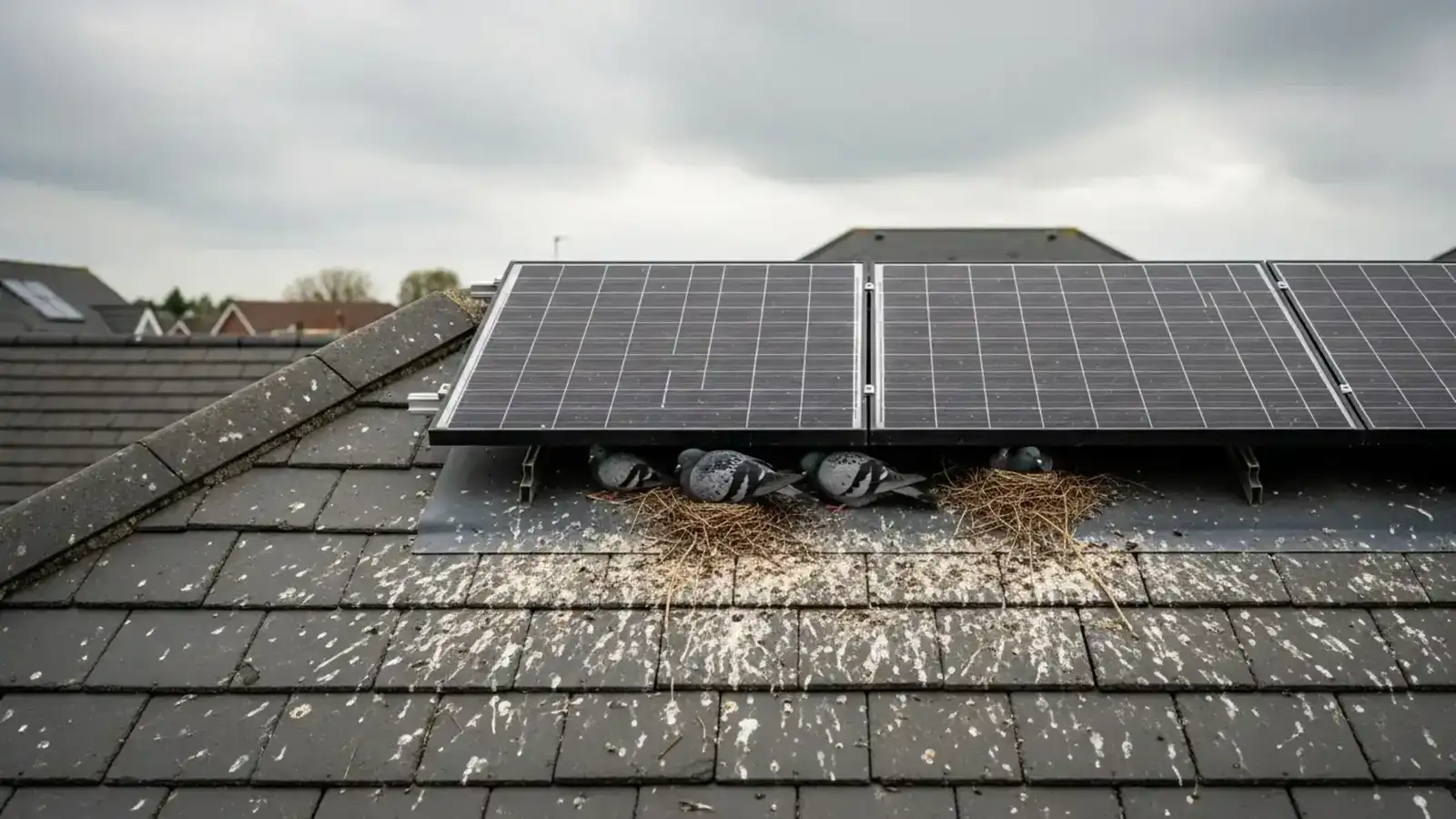
Solar panels create an ideal nesting environment for pigeons. The gap between the panel and the roof provides warmth, shelter from the wind, and protection from predators, making it one of the most attractive nesting sites available in an urban or suburban environment. Once pigeons establish a nest under solar panels, the problem escalates quickly and becomes costly to ignore. We install purpose-designed mesh proofing systems that seal the perimeter of the solar panel array, preventing pigeons from accessing the gap beneath, without drilling into panels or affecting warranties.
What's Included
Why acting quickly matters
Once a pigeon colony establishes beneath solar panels, removal and cleaning costs increase significantly. Pigeons breed year-round with adequate food supply, producing 2 to 3 broods per year. A single pair can quickly attract more birds, and the colony will return season after season unless the panels are proofed. Early action before nesting begins is always more cost-effective.
Need your solar panels proofed before nesting season?
Early action is always more cost-effective. Book a free survey now to protect your panels before pigeons establish a colony.
Request a free call back
Prefer to get in touch another way? Contact us or email info@wynyardpestcontrol.co.uk
Related Services
Threat Assessment
Nuisance:
7/10HIGHPigeons nesting under solar panels cause persistent noise (cooing, scratching), visible droppings on panels, guttering, and the area below the array, and unpleasant odour from accumulated nesting material. Reduced solar panel efficiency from fouling and shading adds ongoing financial cost.
Hazard:
6/10MODERATEPigeon droppings carry Salmonella, E. coli, and Cryptococcus. Nesting material harbours bird mites which can enter the property. Pigeons peck at and dislodge cables, creating fire risk and system failure. Acidic droppings corrode panel frames, roof tiles, and guttering. Many solar panel manufacturers void warranties if damage is caused by pest activity that was not proofed against.
Vital Statistics
| Species | Feral pigeon (Columba livia) |
| Body length | 29 to 35 cm |
| Weight | 250 to 380 g |
| Colour | Blue-grey (other colour variations common) |
| Lifespan | 3 to 5 years (up to 15 in sheltered environments) |
| Broods per year | 2 to 3 (can breed year-round) |
| Eggs per clutch | 2 |
| Incubation period | 17 to 19 days |
| Fledging period | 35 to 37 days in the nest |
| Peak breeding | March to July |
| Flock size | 50 to 500 (gregarious) |
Key Facts
- Pigeon droppings carry Salmonella, E. coli, and Cryptococcus. Nesting material also harbours bird mites which can enter the property.
- Pigeons peck at and dislodge cables beneath solar panels, creating a fire risk and potential system failure.
- Acidic pigeon droppings corrode panel frames, roof tiles, and guttering, causing long-term structural damage.
- Many solar panel manufacturers void warranties if damage is caused by pest activity that was not proofed against.
- Nesting material and droppings block airflow and shade panels, reducing energy output.
- Feral pigeons are covered by General Licence GL41, which permits authorised operators to disturb pigeons and remove nests where they are causing damage to property.
- Once a colony establishes beneath panels, pigeons return season after season unless the panels are proofed.
- Proofing is a permanent solution. Once mesh is installed correctly, no repeat visits are needed unless the system is physically damaged.
Pigeons nesting under your solar panels?
Free survey and fixed-price quotation for businesses and homeowners. Permanent mesh proofing fitted without damage to your panels or warranty.
Why Pigeons Target Solar Panels
Pigeons are drawn to solar panels for several practical reasons that make them one of the most persistent bird problems for property owners across the North East.
- Warmth: Panels retain heat from the sun, keeping the space beneath warm year-round. This is particularly attractive during colder months in Darlington, Durham, and across the North East.
- Shelter: The gap beneath panels is protected from rain, wind, and predators, creating an ideal nesting environment.
- Height: Roof-mounted panels are largely inaccessible, giving pigeons a sense of security from ground-level threats.
- Return behaviour: Once a colony establishes, pigeons return season after season unless the panels are proofed. Feral pigeons are gregarious, living in flocks of 50 to 500, meaning a small problem can quickly become much larger.
Damage Caused by Pigeons Under Solar Panels
Many solar panel manufacturers void warranties if damage is caused by pest activity that was not proofed against.
Leaving a pigeon problem under solar panels unaddressed can result in significant damage and ongoing costs.
- Wiring damage: Pigeons peck at and dislodge cables, creating fire risk and system failure.
- Droppings accumulation: Acidic droppings corrode panel frames, roof tiles, and guttering, causing long-term structural damage.
- Voided warranties: Many solar panel manufacturers void warranties if damage is caused by pest activity that was not proofed against.
- Reduced panel efficiency: Nesting material and droppings block airflow and shade panels, reducing energy output.
- Noise and odour: Active nesting beneath panels causes persistent noise, particularly during the breeding season from March to July.
- Health risk: Pigeon droppings carry Salmonella, E. coli, and Cryptococcus. Nesting material also harbours bird mites which can enter the property through gaps in the roofline.
For businesses with commercial solar installations, unaddressed pigeon activity can also create compliance issues under health and safety regulations. We work with industrial, food businesses, and commercial clients across the North East to protect their solar investments.
Signs You Need Solar Panel Pigeon Proofing
Spotting the signs early and acting before pigeons establish a breeding colony is always more cost-effective than dealing with an established population. Look for:
- Pigeons regularly seen landing on or around your roof or panels
- Cooing or scratching sounds from the roof, particularly in the morning
- Visible droppings on panels, guttering, or the area below the array
- Nesting material (twigs, feathers, debris) visible around the panel edges
- Noticeable drop in solar panel energy output with no other explanation
If you notice any of these signs at your property in Stockton, Middlesbrough, Hartlepool, or elsewhere in the North East, contact us for a free assessment.
Our Solar Panel Proofing Solution
Our clip-on mesh system attaches without drilling, preserving your panels and warranty.
We install a purpose-designed mesh proofing system that seals the perimeter of the solar panel array, preventing pigeons from accessing the gap beneath. The system is:
- Non-invasive: No drilling into panels or roof tiles. Clips attach directly to the panel frame.
- UV and weatherproof: Galvanised or powder-coated steel mesh built to last outdoors. For coastal and marine environments near Hartlepool, North Shields, and South Shields, stainless steel mesh is available as a more corrosion-resistant alternative.
- Low-profile: Barely visible from ground level.
- Permanent: A one-time installation with no ongoing maintenance required.
Before installation, any existing nesting material and droppings are removed and the area is disinfected. This is essential. Proofing over an active nest traps birds and creates further problems. We never proof over an active nest. If birds are actively nesting, we advise on the appropriate timing based on the breeding cycle.
Residential and Commercial Proofing
Residential: Suitable for standard pitched roof installations on terraced, semi-detached, and detached properties. Most domestic installations across Darlington, Durham, Stockton, and the wider North East are completed in a single visit of two to four hours, including cleaning.
Commercial: Large commercial or industrial rooftops with flat-roof solar arrays present a higher-volume challenge. We survey the full array footprint and provide a tailored installation plan. Commercial clients with contracts benefit from priority scheduling and post-installation inspection visits. We work with industrial premises, commercial buildings, agricultural sites, and churches across the region.
All work is carried out by our NPTA-qualified technicians using specialist access equipment where required. We provide free surveys and quotations for businesses and homeowners.
Seasonal Pigeon Nesting Activity in the North East
Hover or tap a month to see Solar Panel Pigeon Proofing activity details
Pigeons remain active year-round. Existing colonies sheltering under panels through winter. Reduced breeding but birds still present.
Early breeding pairs begin establishing nesting sites. Birds actively scouting under solar panels for sheltered locations.
Peak breeding season begins. First clutches laid under solar panels. Nesting material accumulation increases rapidly.
Active nesting and incubation. Young from early clutches developing. Maximum noise and fouling from established colonies.
First broods fledging. Second clutches being laid. Colony size growing as young birds remain near the nest site.
Continued breeding. Multiple generations present under panels. Maximum droppings accumulation and panel efficiency loss.
Late breeding season. Established colonies at maximum size. Significant fouling and debris around panel arrays.
Breeding slows but colonies remain active. Good window for proofing as nesting activity reduces.
Breeding season winding down. Ideal time for proofing before autumn and winter when panels provide warmth.
Pigeons seek warm sheltered roosting sites for winter. Panels become increasingly attractive. Proofing now prevents winter establishment.
Overwintering colonies settle under panels for warmth. Reduced breeding but birds roost in established sites.
Pigeons sheltering under panels through coldest months. Year-round breeding possible in sheltered environments with adequate food.
Pigeons breed primarily from March to July, with peak nesting activity in spring and early summer. However, they can breed year-round in sheltered environments such as beneath solar panels where warmth, shelter, and security are available. The best window for proofing is late summer to early autumn (August to October), after the main breeding season and before pigeons settle into winter roosting patterns.
Book a proofing survey in late summer or early autumn before pigeons establish winter roosting colonies beneath your panels. Early action prevents the accumulation of nesting material and droppings that cause panel damage and efficiency loss.
Spring (March to May) - Breeding season begins: Pigeons begin nesting from early March, and solar panels are a prime target. Pairs scout for warm, sheltered, elevated sites and the gap beneath a panel array ticks every box. Watch for: pairs of pigeons repeatedly landing on or near your panels, twigs and debris appearing in gutters below the array, and increased cooing from the roofline in the early morning. Properties across Darlington, Durham, and Sunderland see a sharp rise in nesting activity during this period. Once a pair lays eggs, they are protected under the Wildlife and Countryside Act 1981 until the chicks fledge.
Summer (June to August) - Peak activity and fouling: Multiple breeding cycles are underway. Pigeon pairs can raise two to three broods per year in typical North East conditions, and established colonies beneath solar panels grow rapidly. Watch for: heavy droppings accumulating on panels and surrounding roof tiles, visible nesting material protruding from panel edges, reduced solar panel output as droppings and debris shade the cells, and bird mites entering the property through the roofline. This is the period of maximum fouling and panel damage. Hartlepool, North Shields, and South Shields coastal properties often see larger colonies due to the proximity of established feral pigeon populations.
Autumn (September to November) - Best proofing window: Breeding slows from late August, making this the ideal window for solar panel pigeon proofing. Nests can be removed without risk of trapping active clutches, and the mesh is installed before pigeons settle into winter roosting patterns. Watch for: pigeons continuing to roost under panels even after breeding stops, droppings hardening on panel surfaces as temperatures drop, and gutters blocked with accumulated nesting material. This is the most cost-effective time to act. Proofing now prevents a winter of further damage and avoids the complications of working around active nests in spring.
Winter (December to February) - Overwintering colonies: Pigeons that have been nesting under your panels all summer do not migrate. They continue roosting through winter, attracted by the warmth that panels retain even in cold weather. Watch for: pigeons entering and leaving the panel array at dawn and dusk, continued droppings accumulation despite lower activity, and damage to wiring and panel frames from prolonged roosting. Feral pigeons are capable of breeding year-round in sheltered environments, and mild winters in the North East increasingly allow winter clutches beneath solar panels.
North East pressure points: Coastal towns including Hartlepool, North Shields, and South Shields experience higher pigeon pressure due to established populations around harbours and town centres. Urban areas of Middlesbrough, Stockton, and Sunderland also see elevated activity, particularly on properties close to commercial areas with food waste. If your property is in a high-pressure area, proofing your solar panels before pigeons establish is the most effective step you can take.
Why Choose Us for Solar Panel Pigeon Proofing
No Panel Damage
Our clip-on mesh system attaches to the panel frame without drilling, cutting, or adhesive. This preserves your solar panel warranty and avoids damage to the mounting rails, frame seals, and waterproofing. The clips are specifically designed for solar panel pigeon proofing and are adjustable to fit all major panel types.
Full Cleaning Included
Every solar panel pigeon proofing installation includes complete removal of all guano, nesting material, and debris from beneath the panels. The panels and surrounding roof area are then cleaned and disinfected with a biocide treatment before the mesh is fitted. You receive a clean, proofed system ready to perform at full efficiency.
Long-Lasting Protection
Galvanised steel mesh is built to withstand UV exposure, rain, and frost for the full lifetime of your solar panel system. For coastal properties in Hartlepool, North Shields, and South Shields where salt corrosion is a factor, we offer stainless steel mesh as a corrosion-resistant alternative.
Free Site Survey
We carry out a thorough inspection of your solar panel array, assess the extent of pigeon activity, check for nesting material and wiring damage, and provide a fixed-price quotation on the spot. No obligation for businesses or homeowners. Commercial clients can combine the survey with a broader bird control assessment.
NPTA Member
All solar panel pigeon proofing is carried out by NPTA-qualified technicians trained in safe working at height, wildlife legislation, and professional pest management standards. NPTA membership means our work is insured, auditable, and compliant with industry codes of practice.
DIY vs Wynyard Pest Control
| DIY | Wynyard Pest Control | |
|---|---|---|
| Mesh quality | Plastic or lightweight mesh | ✓ Galvanised or stainless steel |
| Panel warranty | ⚠ Risk of voiding | ✓ No drilling, warranty safe |
| Nest and guano removal | ✗ Not included | ✓ Full cleaning and disinfection |
| Safe roof access | ✗ Risk of falls | ✓ Specialist access equipment |
| Longevity | 1 to 3 years (plastic degrades) | ✓ Lifetime of the panels |
| Health and safety | ⚠ Exposure to droppings | ✓ PPE and biocide treatment |
| Workmanship guarantee | ✗ None | ✓ Full guarantee |
DIY solar panel pigeon proofing kits are available, but they come with significant limitations and risks.
When DIY may be sufficient: If you have a small ground-mounted solar array that is easily accessible and pigeons have not yet established a nesting colony. In this scenario, a DIY plastic mesh kit may provide temporary protection.
When you need Wynyard Pest Control: For any roof-mounted solar panels, whether residential or commercial, professional installation is strongly recommended. Working at height carries a serious risk of falls. Pigeon droppings carry diseases including Salmonella and E. coli, requiring proper PPE and biocide treatment. DIY plastic mesh degrades in UV light within 1 to 3 years and often fails at the clips, allowing pigeons to re-enter. Professional galvanised steel mesh is built to last the lifetime of your solar panels.
Prevention and Aftercare
Once the mesh system is installed, pigeons are permanently excluded from nesting under the panels. The mesh requires no ongoing maintenance under normal conditions.
We recommend a visual check at 12 months to ensure clips remain secure. This can be combined with any other scheduled pest control visit. If you notice any damage from storms or falling branches, contact us and we will inspect and repair the system.
For properties where pigeons are also roosting on other areas of the building (ledges, guttering, chimney stacks), we can combine solar panel proofing with additional bird deterrent systems such as spikes, wire systems, or netting to address the wider problem.
Legislation and Legal Compliance
Feral pigeons (Columba livia) are covered by General Licence GL41, issued by DEFRA Natural England. This licence permits authorised operators to disturb feral pigeons, remove active nests, and take eggs where they are causing damage to property.
All work we carry out is conducted within the terms of GL41, ensuring it is both lawful and humane. Our technicians are trained in wildlife legislation and understand the legal requirements for bird management across the North East.
We never proof over an active nest without first removing the nesting material in accordance with the licence. If birds are actively nesting with young chicks present, we advise on appropriate timing to ensure compliance with the Wildlife and Countryside Act 1981.
What to Expect During Your Visit
Most residential solar panel proofing installations are completed in two to four hours, including cleaning.
Free survey: We inspect your solar panel array, assess the extent of pigeon activity, check for nesting material and droppings, and recommend the most appropriate proofing solution. For residential properties, the survey and quotation are provided on the same visit where possible.
Installation day: Our technicians arrive with all materials and specialist access equipment. The process follows a clear sequence:
- Safe access to the roof established using ladders, scaffolding, or roof access equipment as appropriate
- All existing nesting material, eggs, and guano removed
- Panels and surrounding roof area cleaned and disinfected
- Galvanised steel mesh fitted around the perimeter of the panel array using specialist clips that attach to the panel frame without drilling
- All edges checked and secured to ensure no gaps remain
- Final inspection and clean-up of the work area
For commercial installations, the scope is agreed in advance and the work is scheduled to minimise disruption to operations.
Our Solar Panel Pigeon Proofing Process
A structured, three-stage approach that treats the problem and prevents it returning.
Step 1
Inspect and Plan
A detailed property inspection identifies entry points, infestation hotspots, and the species involved. A targeted treatment plan is developed based on findings.
Step 2
Treatment
Professional control measures are applied using advanced techniques and CRRU-compliant products. Proofing and sealing work addresses the root cause at the same time.
Step 3
Ongoing Support
Follow-up visits confirm the problem is resolved. You receive clear documentation, prevention advice, and recommendations for ongoing protection.
Pigeons nesting under your solar panels?
Free survey and fixed-price quotation for businesses and homeowners. Permanent mesh proofing fitted without damage to your panels or warranty.
Safety Considerations
Solar panel pigeon proofing involves working at height and handling contaminated materials. Our technicians follow strict health and safety procedures throughout every installation.
- Working at height: All roof work is carried out using appropriate access equipment in compliance with the Work at Height Regulations 2005. We never ask homeowners to access their own roofs.
- Contaminated materials: Pigeon droppings carry bacteria and fungal spores that can be harmful when disturbed. Our technicians wear full PPE including respiratory protection, gloves, and coveralls. All waste is bagged and removed from site for safe disposal.
- Electrical safety: Solar panels generate electricity when exposed to light. Our technicians are trained to work safely around photovoltaic systems and do not interfere with electrical connections.
Homeowners and occupants do not need to vacate the property during installation. All work is carried out externally on the roof.
NPTA Member
We are full members of the National Pest Technicians Association (NPTA). This means our technicians meet strict training and competency standards, carry appropriate insurance, and follow the association's code of practice. NPTA membership is your assurance that the work is carried out professionally and responsibly.
Fair, Transparent Pricing
Every job is different. The cost depends on the type of pest, scale of the problem, and what treatment is needed. We provide a free assessment and an honest quotation before any work begins. No hidden costs, no surprises.
View our pricing guideSatisfaction Guaranteed
Every solar panel pigeon proofing installation is backed by our workmanship guarantee. The mesh system is designed to last the lifetime of your solar panels. If any clips or fixings fail under normal conditions, we will return and repair at no extra cost.
Frequently Asked Questions
Yes. We never proof over an active nest. All nesting material is removed and the area cleaned and disinfected before the mesh is fitted. If birds are actively nesting, we advise on the appropriate timing based on the breeding cycle.
No. Our clip-on system attaches to the panel frame without drilling. In most cases, proofing the panels actually protects your warranty by preventing bird damage.
No. The mesh is fitted around the perimeter of the array, not over the panel surfaces. It does not shade the panels or restrict airflow. In fact, removing accumulated guano and debris from under and around the panels often improves efficiency.
Most residential installations are completed in two to four hours depending on the size of the array, including cleaning. Commercial installations are scoped individually based on the array size and access requirements.
Early action is always more cost-effective. Once a colony establishes beneath panels, removal and cleaning costs increase significantly. If pigeons are regularly visiting your roof, proofing is strongly recommended before nesting begins.
Proofing is a permanent solution. Once the mesh is installed correctly, no repeat visits are needed unless the system is physically damaged. We recommend a visual check at 12 months, which can be combined with any other scheduled pest control visit.
Feral pigeons (Columba livia) are covered by General Licence GL41, issued by DEFRA Natural England. This licence permits authorised operators to disturb feral pigeons, remove active nests, and take eggs where they are causing damage to property. All work we carry out is conducted within the terms of GL41, ensuring it is both lawful and humane.
Yes. Our treatments target the infestation identified at the time of service. If pest activity related to the treated infestation returns within the agreed service period, we will revisit and carry out additional treatment where necessary at no extra cost. For commercial clients on contract, our pest management programmes include scheduled inspections, monitoring, and rapid response call-outs, along with audit-ready documentation to support compliance requirements. Please note that our service warranty applies only to the infestation originally treated and does not cover new infestations or conditions outside our control, such as structural entry points or environmental factors. Where long-term prevention requires proofing work or environmental changes, our technicians will provide recommendations.
Related Services
Our Other Services
Areas We Cover
We provide solar panel pigeon proofing services across the North East of England.
Ready to talk to us?
Free survey and quotation for businesses and homeowners. No obligation, no pressure.
We will get back to you as soon as we can.